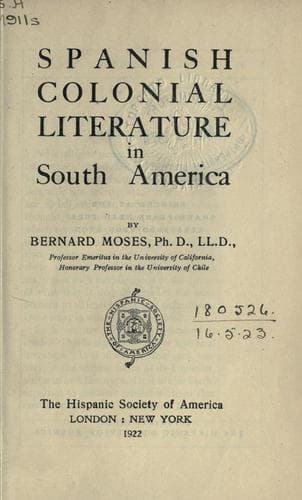
Spanish colonial literature in South AmericaMoses, Bernard
History
Spanish colonial literature in South America
Moses, Bernard
Spanish American literature -- History and criticism
Under the title of _Histoire du Pérou_ M. Ternaux-Compans published at
Paris in 1840 a translation of a part of the writings of Cabello de
Balboa. The author had been a soldier before he became an ecclesiastic.
He went from Spain to America in 1566. For a certain period he lived in
Bogotá, but later went to Quito, where in 1576, under the protection of
Pedro de la Peña, the bishop, he began the composition of his _Miscelánea
austral_, which, according to a statement at the end of the work, he
completed on July the ninth, 1586. Balboa, like many other chroniclers of
his time, thought it desirable to begin his narrative with the creation
of the world, and in the first two of the three parts into which it is
divided he makes no mention of America whatsoever. In the third part
he deals with the history of Peru, but at the same time makes frequent
reference to events that have no relation to the history of America.
[Illustration: Francisco de Toledo, 5th Viceroy of Peru 1569-1581]
V
[Sidenote: Frontier of Chile]
The development in the southern part of the continent was slower than in
Peru. In Chile at the beginning of the half-century in question, a number
of garrisoned posts had been established on the southern frontier, where
the inhabitants lived in the presence of the hostile Araucanians. Some
of these posts grew into towns, but the residents, whether soldiers or
civilians, had always before them the spectre of an Indian War; and it
was this war that furnished the epic theme of their earliest literature.
After the establishment of Valdivia and his colonists in Chile, that
country formed a new province, a new centre of local government, within
the viceroyalty that had Lima as its capital. The European advance
towards the south encountered the stout resistance of the Araucanians,
and the experience gained in this conflict appears to have furnished
a motive for writing, and awakened a desire to transmit to posterity
accounts of the events they had observed and of enterprises in which
they had participated.
[Illustration: Pedro de Valdivia]
[Sidenote: Portrait of Valdivia]
[Sidenote: Valdivia as a writer]
Public-domain text, read in full here on John Shaqi.
Reviews
Reviews
No reviews yet
Be the first to share your thoughts on this work.
Elsewhere in the archive
Join the Discussion
Join the discussion
Sign in to leave a comment or review.
Sign InorCreate an account