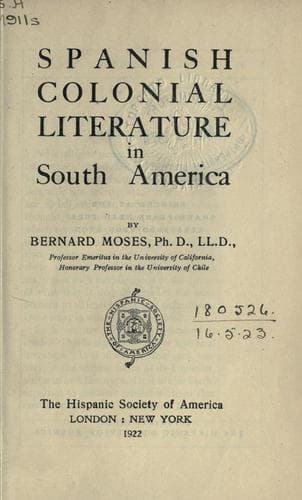
Spanish colonial literature in South AmericaMoses, Bernard
History
Spanish colonial literature in South America
Moses, Bernard
Spanish American literature -- History and criticism
Pedro de Valdivia is not thought of as a writer, yet his letters deserve
recognition, whether regarded as stories of great adventure or as
sources of the early history of Chile. Warriors are less often given to
writing than priests, but when they undertake the task their productions
sometimes have a quality not attained by the literary efforts of
ecclesiastics. Valdivia wrote as a warrior might be expected to write: he
discussed his tasks of military organization, the extreme want he had to
face in effecting his settlement and domination in Chile, his labours in
the service of the king, and the exasperating conduct of his enemies. His
superior spirit as a man appears in the clearness of his language, in his
lack of pretension, in his energy, and in an unwearying consciousness of
his own high purpose. In writing he evidently set down the word that came
first to his mind, that seemed to him to be the word for the idea, and
made little or no effort to polish his phrases after the manner of the
schools. His _Cartas_, therefore, constitute a work that, of its kind, as
Medina has observed, has not been surpassed in Chile.[49]
VI
Two other writers of this southern province were Marmolejo and Lovera.
They had little literary training, and were apparently not moved by
ambition for literary distinction, but simply by the thought that they
ought to communicate to their countrymen their first-hand knowledge of
strange natural phenomena and unfamiliar social movements, as well as
their experience as soldiers.
[Sidenote: Góngora Marmolejo]
[Sidenote: Marmolejo’s _Historia_]
Alonso de Góngora Marmolejo’s _Historia del reino de Chile_ is an
important early narrative of Chilean warfare and adventure. The author
went from Peru in a body of auxiliaries, taken by Pedro de Valdivia
for service in his campaign for the conquest of Chile, where, for a
period of forty years, after 1547, he accumulated honours, but saw
his wealth gradually decrease. Then, under the affliction of poverty
and disappointment, he undertook to set down and leave to posterity
an account of the events, in which he had had part, and of the actors
who had been his companions. Halted in the performance of this task by
discouragement and the fear of criticism, he nevertheless worked on to
the last sentence, which announced the fact that his work was completed
in the city of Santiago, in the kingdom of Chile, on the 16th of
December, 1575. During the brief period of his life that remained after
this date, little is known of him, except that he was charged by Rodrigo
de Quiroga, noted for his superstition, fanaticism, and intolerance,
to traverse the country occupied by the Indians, and to find out and
punish severely those guilty of the crime of witchcraft. But as Quiroga
appointed Pedro de Lisperguer to the same office on January 23, 1576, it
is inferred that Marmolejo’s incumbency was short.
Public-domain text, read in full here on John Shaqi.
Reviews
Reviews
No reviews yet
Be the first to share your thoughts on this work.
Elsewhere in the archive
Join the Discussion
Join the discussion
Sign in to leave a comment or review.
Sign InorCreate an account