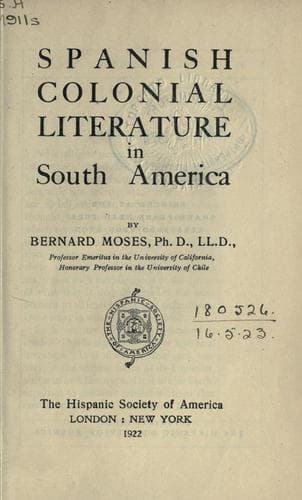
Spanish colonial literature in South AmericaMoses, Bernard
History
Spanish colonial literature in South America
Moses, Bernard
Spanish American literature -- History and criticism
But Marmolejo’s fears of the critics were not realized. They have found
his narrative animated, without the digressions that appealed to the
taste of his time, free from tiresome repetitions and never departing
from the course of events to picture imaginary customs of the Indians.
In spite of distance and time he makes one turn back and live with a
remote generation, causing one to experience the impressions the scenes
narrated must have made on the eye-witness. His style partakes somewhat
of the rudeness of the primitive conquistadores, but is always fresh and
spontaneous.[50]
Among the motives that induced Marmolejo to write, according to his own
statement, were his sense of the large number of happenings in Chile that
should be recorded and that the only written account of them was found
in Ercilla’s _Araucana_, “not so full as would be necessary in order to
treat properly of all of the affairs of the kingdom.”[51]
[Sidenote: Barros Arana on Marmolejo]
Without denying the directness and vividness of Marmolejo’s narrative
Barros Arana points out the technical defects of the composition, the
absence of literary art in the presentation of facts, and the lack of
due emphasis on the most notable incidents. Marmolejo wrote almost
exclusively of events of which he had personal knowledge, whence his
chronicle is confined almost entirely to military affairs. He gave
little information of any other class of events and left his chronology
defective. Writing a personal narrative, he was not careful to fix
adequately his dates, thus obliging future historians to have recourse to
other sources of knowledge, if they would make a complete history of the
period covered by the author’s experience.[52]
[Illustration: Jerónimo de Alderete]
[Sidenote: _Historiadores de Chile_]
Marmolejo’s narrative, in printed form, occupies two hundred and twelve
pages of the _Colección de historiadores de Chile_, and deals with
the events of Chilean history during the forty years prior to 1575.
No single extract is likely to reveal much of the author’s quality,
particularly when the paragraph quoted is translated into a language as
far removed as English is from the original Spanish; yet some features
of the author’s simple and familiar manner may be discovered even in
a translation. The following paragraph on Alderete’s appointment as
Valdivia’s successor may serve as an illustration:
[Sidenote: Marmolejo on Alderete]
Public-domain text, read in full here on John Shaqi.
Reviews
Reviews
No reviews yet
Be the first to share your thoughts on this work.
Elsewhere in the archive
Join the Discussion
Join the discussion
Sign in to leave a comment or review.
Sign InorCreate an account