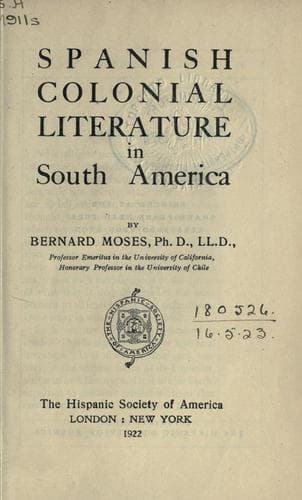
Spanish colonial literature in South AmericaMoses, Bernard
History
Spanish colonial literature in South America
Moses, Bernard
Spanish American literature -- History and criticism
[Sidenote: The early cantos]
Some part of _La Araucana_ was written amid the scenes, and in connexion
with the events, described. In his _Prólogo_ Ercilla has stated that
he wrote at hours stolen from the occupations of war in Chile, and
sometimes on pieces of leather or of hides for want of paper, or on
fragments of letters often only large enough to hold six lines; and it
often required much effort and trouble to arrange these fragments in
their proper order. This method of writing, as the author confesses,
gave to his poem in some respects the quality of a journal in verse.
This was especially true of those parts that were written during the
campaign against the Araucanians, dealing with what he saw or with
the events in which he participated; and these parts may be accepted
as having the historical authority of a contemporary chronicle. This
quality may be more particularly ascribed to the first fifteen cantos,
the first published after the author’s return to Spain. And these cantos,
during the seven years between the author’s arrival in Europe and their
publication, underwent extensive modification and elaboration. It does
not, however, appear probable that much if any of the second part was
written in America, but that the author undertook it, “having promised to
continue this history.” In the preface to the second part he affirms that
he has continued it with no little difficulty and ennui, on account of
the severity and monotony of the material, “since from the beginning to
the end it contains only one and the same subject.”
The composition of _La Araucana_ was interrupted many times by the
author’s journeys and his diplomatic services. After Ercilla’s return
to Spain the events of the Indian wars and the spirit of the contending
parties gradually became indistinct in his mind. He departed from his
original purpose “not to sing of love and the gallantry of enamoured
knights,” and, under the influence of Italian models, introduced
invented tales of romantic adventure, leaving the poem, in some sense, a
mechanical mixture of historical narrative and romantic episodes.
[Sidenote: Ercilla wanted a hero]
Public-domain text, read in full here on John Shaqi.
Reviews
Reviews
No reviews yet
Be the first to share your thoughts on this work.
Elsewhere in the archive
Join the Discussion
Join the discussion
Sign in to leave a comment or review.
Sign InorCreate an account