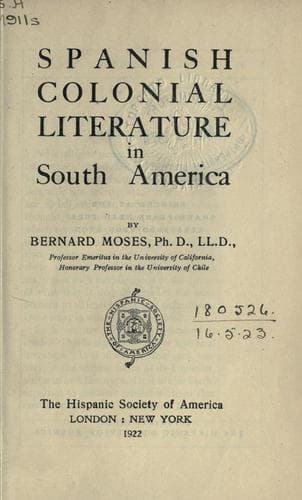
Spanish colonial literature in South AmericaMoses, Bernard
History
Spanish colonial literature in South America
Moses, Bernard
Spanish American literature -- History and criticism
The Araucanian war presented no leader on either side whose prominence
entitled him to be treated as the prominent hero of the conflict. For
this reason Ercilla is obliged to allow one figure after another to
occupy the centre of the stage. Although his purpose was to glorify
Spanish arms, the heroes who have appealed most strongly even to the
inhabitants of Chile are the Araucanian chiefs. In the struggle for
emancipation from Spain the Chileans were especially incited to action
by the heroism of Caupolicán, Lautaro, Tucapel, Colocolo, and Galvarino.
Parents named their children after these heroes, and the name of
Lautaro was applied to the patriotic association of the early advocates
of Spanish-American independence. Thus the inspiring figures in the
narrative of the war are not the Spanish but the Indian leaders. It is
quite possible that Ercilla’s resentment at the treatment he received
at the hands of García de Mendoza prevented the commander’s figure from
assuming greater importance in the poem.
[Illustration: Statue of Caupolicán in Santiago de Chile]
[Sidenote: The magnified chiefs]
Lautaro is described as a young man of medium height, solidly formed,
with strong limbs and strong shoulders, and endowed with moral
qualities not less advantageous than his physical qualities; audacious
and unafraid, prompt to act, resourceful and heroic under critical
circumstances; when the circumstances allowed him leisure, he knew how
to prepare slowly and carefully for a difficult enterprise, to take as
his soldiers even the most reckless and villainous of the Araucanians,
to subject them to an iron discipline, and to inspire in them love and
admiration for a chief who punished implacably with death the slightest
infraction of his orders; yet in the story of the love that existed
between him and the beautiful Guacolda the poet has revealed the gentler
traits of his hero’s character.[61]
[Sidenote: Caupolicán]
In the list of Araucanian heroes an especially prominent place is
accorded to Caupolicán, as typifying the strength and pride of his
people, their contempt of pain and even of death. Ercilla gives the
following description of him in the forty-seventh octave of the second
canto:
Era este noble mozo de alto hecho,
Varón de autoridad, grave y severo,
Amigo de guardar todo derecho,
Áspero y riguroso justiciero,
De cuerpo grande y relevado pecho,
Hábil, diestro, fortísimo y ligero,
Sabio, astuto, sagaz, determinado,
Y en casos de repente reportado.[62]
[Sidenote: Tucapel]
Public-domain text, read in full here on John Shaqi.
Reviews
Reviews
No reviews yet
Be the first to share your thoughts on this work.
Elsewhere in the archive
Join the Discussion
Join the discussion
Sign in to leave a comment or review.
Sign InorCreate an account