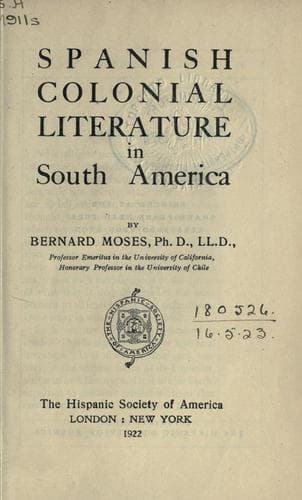
Spanish colonial literature in South AmericaMoses, Bernard
History
Spanish colonial literature in South America
Moses, Bernard
Spanish American literature -- History and criticism
“Que esta flaca persona, atormentada
De golpes de fortuna, no procura
Sino el agudo filo de una espada,
Pues no la acaba tanta desventura.
Aquella vida es bien afortunada
Que la temprana muerte la asegura;
Pero, a nuestro bien público atendiendo,
Quiero decir en esto lo que entiendo.
“Pares sois en valor y fortaleza;
El cielo os igualó en el nacimiento;
De linaje, de estado y de riqueza
Hizo a todos igual repartimiento;
Y en singular por ánimo y grandeza
Podéis tener del mundo el regimiento:
Que este gracioso don, no agradecido,
Nos ha al presente término traído.
“En la virtud de vuestro brazo espero
Que puede en breve tiempo remediarse,
Mas ha de haber un capitán primero
Que todos por él quieran gobernarse:
Este será quien más un gran madero
Sustentare en el hombro sin pararse;
Y pues que sois iguales en la suerte,
Procure cada cual de ser más fuerte.”
Canto II., Oct. 28, et seq.[63]
[Illustration: García Hurtado de Mendoza, 8th Viceroy of Peru 1590-1596]
[Sidenote: García de Mendoza]
[Sidenote: Ercilla on Ercilla]
The prominent Spaniards are sketched less clearly than the Indians,
appealing apparently less powerfully to the poet’s imagination. Yet the
sketch of García de Mendoza, the youthful commander of the expedition,
appears exaggerated when it is remembered that he was a youth of
twenty-one and that some of his actions showed a wisdom not beyond
his years. But among the characters that appear in the poem, not the
least conspicuous is Ercilla himself. The references to his journeys
and explorations throw an important side-light on the early history of
Chile. These references, moreover, show him as a champion of the more
admirable features of civilization. He opposes the useless cruelty of
his compatriots; he is humane towards the vanquished; proud to repel the
indignities offered by the commander; religious but not fanatical; a
knight of the Middle Ages, animated by a certain pride in enduring the
hardships and facing the dangers presented by a barbarous enemy in an
unexplored region; a chivalrous hero, but too sober-minded to be drawn
into quixotic enterprises.[64]
[Sidenote: Ercilla’s limited knowledge of Indians]
[Sidenote: The poet’s philosophy]
Public-domain text, read in full here on John Shaqi.
Reviews
Reviews
No reviews yet
Be the first to share your thoughts on this work.
Elsewhere in the archive
Join the Discussion
Join the discussion
Sign in to leave a comment or review.
Sign InorCreate an account