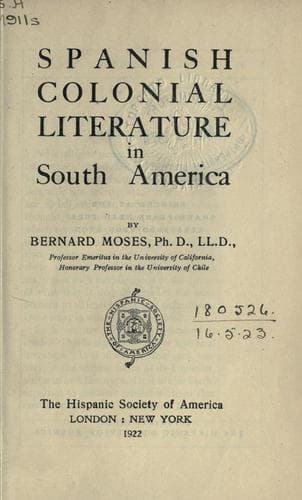
Spanish colonial literature in South AmericaMoses, Bernard
History
Spanish colonial literature in South America
Moses, Bernard
Spanish American literature -- History and criticism
It was Ercilla’s fate to be imitated not only by writers of talent, but
also by a stupid writer who essayed to continue or to complete his epic.
This was Diego de Santistevan Osorio, who undertook a work that was
designed to be written in the style of Ercilla’s poem and to continue
the story of the Indian war and Ercilla’s part in it. It was called the
fourth and fifth parts of _La Araucana_.[82] But in every respect it
falls far below its forerunner. Medina characterizes it as the production
of a juvenile brain rendered enthusiastic by reading a masterpiece
written by one intensely interested in his subject.[83]
Biographical knowledge of Santistevan Osorio is limited to a few facts:
that he was born in León in Spain; that he published his principal work
in 1597; and that he published another work on the wars of the knights
of Malta and the capture of Rhodes.
[Sidenote: Character of Osorio’s work]
The continuation of _La Araucana_ is composed of two parts, the first
part embracing thirteen cantos, and the second part twenty. One of the
noteworthy features of Santistevan’s work is the reckless mingling of
the Virgin Mary and the characters of pagan mythology. Then out of
the depths of his imagination the author calls forth a being whom he
designates Caupolicán the Second; and in the course of the narrative one
encounters Zoroaster, Dido, Semiramis and Zenobia, not to mention less
conspicuous ornaments of ancient history and mythology; and these are all
jumbled together in obscure confusion. The independence, the stoicism
and bravery that Ercilla found in the enemy do not appear in the Indians
as presented by Santistevan Osorio. Here they are timid, shrinking, and
brought into battle only by the employment of various incentives. The
moral reflections with which the author introduces the several cantos
are vapid dissertations on the instability of fortune. The strength and
the passion which move heroes to action seem to appear to our author as
mistakes of creation.
These early “historical poems” continued to impress their style upon
later writers both in Spain and America, and to call American affairs to
the attention of the people of Europe. Gabriel Lasso de la Vega wrote _La
Mexicana_, published first in 1588 under the title of _Cortés valeroso_.
The theme of the poem on Chilean affairs was taken up by the stage in
Spain. _Algunas hazañas de las muchas de Don García Hurtado de Mendoza_
was a mediocre work by a number of authors. _Arauco domado_, by Lope de
Vega, had Ercilla as one of its characters; he appeared on the stage
beating a drum. Other dramas dealing with the same general subject were
_Gobernador Prudente_, by Gaspar de Ávila, and _Españoles en Chile_, by
Francisco González de Bustos. In the drama by Bustos the baptism of a
prominent Indian chief, the empalement of Caupolicán, and the greatness
of the family of Mendoza are presented as three of Spain’s claims to
distinction.
CHAPTER VII
JUAN DE CASTELLANOS
Public-domain text, read in full here on John Shaqi.
Reviews
Reviews
No reviews yet
Be the first to share your thoughts on this work.
Elsewhere in the archive
Join the Discussion
Join the discussion
Sign in to leave a comment or review.
Sign InorCreate an account