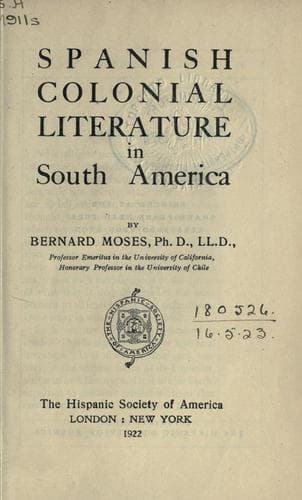
Spanish colonial literature in South AmericaMoses, Bernard
History
Spanish colonial literature in South America
Moses, Bernard
Spanish American literature -- History and criticism
[Sidenote: Castellanos in New Granada]
[Sidenote: Jiménez de Quesada]
[Sidenote: Quesada’s manuscript]
Besides Ercilla and his imitators, already mentioned, a number of other
writers in verse appeared among the early chroniclers of South American
affairs. The most noteworthy of these were Juan de Castellanos, of Tierra
Firme, Martín del Barco Centenera, of Tucumán and Paraguay, and Pedro
Peralta Barnuevo, of Peru. The position of Castellanos in relation to
the literary history of New Granada, or Colombia, may be compared with
that of Ercilla with respect to Chile; but the name of Castellanos in the
New Granadan catalogue is preceded by that of Jiménez de Quesada, the
discoverer of the territory of the Chibchas and the founder of Bogotá.
Quesada was born in Córdoba, but his boyhood was spent in Granada, where
his father, Luis Jiménez de Quesada, was a judge. He studied law, and
was graduated with the title of licenciado. Under Governor Lugo he was
the chief judicial officer of the colony of Santa Marta, and from this
post he was advanced to the leadership of the expedition sent to explore
the interior of the country. Having established a settlement on the
plateau, August 6, 1538, he returned to Europe in 1539. His account of
this expedition was called _Compendio historial_. Lucas Fernández de
Piedrahita (1624-1688) affirms, in the _Prólogo_ of his _Historia general
de las conquistas del nuevo reino de Granada_, that the manuscript of the
_Compendio historial_ was sent to Spain, where he saw it in one of the
libraries of Madrid. It is also reported that for many years it was in
the possession of the national library at Bogotá, and that the historian
Antonio Plaza took it from the library about 1848, and used it in writing
his history of New Granada; moreover, that it was lost among Plaza’s
papers after that writer’s death, which occurred in 1854. Parts of it are
preserved in the quotations made from it by Plaza and Zamora. A few of
these extracts have been reprinted by Vergara y Vergara in his _Historia
de la literatura en Nueva Granada_. The _Epítome de la conquista del
Nuevo Reino_, by Quesada, recently published by M. Jiménez de la Espada,
is found to be different, at least in part, from the original _Compendia
historial_.
[Illustration: Juan de Castellanos]
The events of Quesada’s march from the sea to the table-land, the coming
of Benalcázar from the south, the appearance of Federmann making his
way through the wilderness from Venezuela, the meeting of the three
captains, and the ceremonies attending the announcement and confirmation
of Spain’s claim to the land furnished themes fit for romances framed
after the model of the _Cid_. The most noteworthy writer who made use of
this material and presented it in verse was Juan de Castellanos; but his
work, written in his old age, is rather a history than a romance; it is a
metrical chronicle of the early history of New Granada.[84]
[Sidenote: Juan de Castellanos]
Public-domain text, read in full here on John Shaqi.
Reviews
Reviews
No reviews yet
Be the first to share your thoughts on this work.
Elsewhere in the archive
Join the Discussion
Join the discussion
Sign in to leave a comment or review.
Sign InorCreate an account