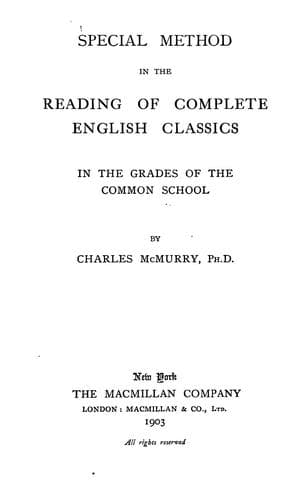
Special Method in the Reading of Complete English Classics: In the Grades of the Common SchoolMcMurry, Charles A. (Charles Alexander)
General
Special Method in the Reading of Complete English Classics: In the Grades of the Common School
McMurry, Charles A. (Charles Alexander)
American literature -- Study and teaching; English literature -- Study and teaching
"After all, a man acts so because he is so. And what each man is, that
Shakespeare reveals to us most immediately; he demands and obtains our
belief, even for what is singular and deviates from the ordinary course
of nature. Never perhaps was there so comprehensive a talent for
characterization as Shakespeare. It not only grasps every diversity of
rank, age, and sex, down to the lispings of infancy; not only do the
king and the beggar, the hero and the pickpocket, the sage and the
idiot, speak and act with equal truthfulness; not only does he transport
himself to distant ages and foreign nations, and portray with the
greatest accuracy (a few apparent violations of costume excepted) the
spirit of the ancient Romans, of the French in the wars with the
English, of the English themselves during a great part of their history,
of the Southern Europeans (in the serious part of many comedies), the
cultivated society of the day, and the rude barbarism of a Norman
foretime; his human characters have not only such depth and
individuality that they do not admit of being classed under common
names, and are inexhaustible even in conception,--no, this Prometheus
not merely forms men, he opens the gates of the magical world of
spirits."
What is true of Shakespeare in a preëminent degree is true to a marked
extent of all the great novelists and poets.
The teacher needs to possess great versatility and tact in social
situations. A quick insight, social ease, freedom, and self-possession
are of the first importance to him. The power of sympathy, of
appreciation for others' feelings and difficulties, is wholly dependent
upon such social cultivation. Otherwise the teacher will be rude, even
uncouth and boorish in manner, producing friction and ill-will where
tact and gentleness would bring sympathy and confidence. Many people
absorb this refinement of thought and manner from the social circles
with which they mingle, and it is, of course, a smiling fortune that has
placed a teacher's early life in a happy and cultured atmosphere, where
the social sympathies and graces are absorbed almost unconsciously. But
even where the earlier conditions have been less favorable, the
opportunity for rapid social development and culture is most promising.
The numberless cases in our country in which young people, by the
strength of their energetic purpose and desire for improvement, have
raised themselves not only to superior knowledge and scholarship, but
also to that far greater refinement of social life and manner which we
call true culture,--the numberless instances of this sort are a
surprising indication of the power of education. Literature has been a
potent agent in this direction. It emancipates, it sets free, the spirit
of man. It lifts him above what is sordid and material, and gives him
those true standards of worth with which to measure all things. It
contains within itself the refining elements, the æsthetic and ethical
Public-domain text, read in full here on John Shaqi.
Reviews
Reviews
No reviews yet
Be the first to share your thoughts on this work.
Elsewhere in the archive
Join the Discussion
Join the discussion
Sign in to leave a comment or review.
Sign InorCreate an account