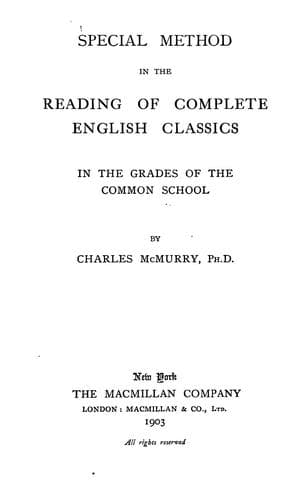
Special Method in the Reading of Complete English Classics: In the Grades of the Common SchoolMcMurry, Charles A. (Charles Alexander)
General
Special Method in the Reading of Complete English Classics: In the Grades of the Common School
McMurry, Charles A. (Charles Alexander)
American literature -- Study and teaching; English literature -- Study and teaching
ideals, and, best of all, it portrays human life in all its thought,
feeling, and passion with such intensity and realistic fidelity that its
teaching power is unparalleled.
This potentiality of the better literature to produce such noble results
in the higher range of culture is dependent upon conditions. No one will
understand literature who does not study and understand ordinary life as
it surrounds him; who does not constantly draw upon his own experience
in interpreting the characters portrayed in books. No stupid or
unobservant person will be made wise through books, be they never so
choice. Even the student who works laboriously at his text-books, but
has no eye nor care for the people or doings about him, is getting only
the mechanical side of education, and is losing the better part. He who
will draw riches out of books must put his intellect and sympathy, his
whole enthusiastic better self, into them.
The indwelling virtue of great books is that they demand this intense
awakening, this complete absorption of the whole self. The mind of a
child and of a man or woman has to stretch itself to the utmost limit to
take in the message of a great writer. One feels the old barriers giving
way and the mind expanding to the conception of larger things. Speaking
of the ancient drama at Athens, Shelley says, "The imagination is
enlarged by a sympathy with pains and passions so mighty that they
distend in their conception the capacity of that by which they are
conceived."
Those who have received into the inner self the expansive energy of
noble thought and social culture, are the better qualified, from the
rich variety of the inner life, to act effectively upon the complex
conditions and forces of the outer world. The teacher whose inner life
is teeming with these rich sympathies and potent ideals will react with
greater prudence and tact upon the kaleidoscopic conditions of a school.
Practical social life and literature are not distinct modes of culture.
They are one, they interact upon each other in scores of ways. Give a
teacher social opportunities, give him the best of our literature, let
these two work their full influence upon him,--then, if he cannot become
a teacher, it is a hopeless case. Let him go to the shop, to the farm,
to the legislature; there is no place for him in the schoolroom.
Literature is also a sharp and caustic critic of his own follies or
foibles, to one who can reflect. It has a multitude of surprises by
which we are able, as Burns wished,--
"To see oursels as ithers see us."
Even the schoolmaster finds an occasional apt description of himself in
literature which it is often interesting and entertaining for him to
ponder. One of the most familiar is that of Goldsmith in "The Deserted
Village":--
Public-domain text, read in full here on John Shaqi.
Reviews
Reviews
No reviews yet
Be the first to share your thoughts on this work.
Elsewhere in the archive
Join the Discussion
Join the discussion
Sign in to leave a comment or review.
Sign InorCreate an account