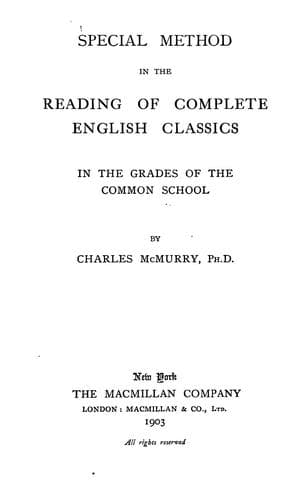
Special Method in the Reading of Complete English Classics: In the Grades of the Common SchoolMcMurry, Charles A. (Charles Alexander)
General
Special Method in the Reading of Complete English Classics: In the Grades of the Common School
McMurry, Charles A. (Charles Alexander)
American literature -- Study and teaching; English literature -- Study and teaching
"Beside yon straggling fence that skirts the way
With blossomed furze unprofitably gay,
There, in his noisy mansion, skill'd to rule,
The village master taught his little school.
A man severe he was, and stern to view;
I knew him well, and every truant knew:
Well had the boding tremblers learn'd to trace
The day's disasters in his morning face;
Full well they laugh'd, with counterfeited glee,
At all his jokes, for many a joke had he;
Full well the busy whisper, circling round,
Convey'd the dismal tidings when he frown'd.
Yet he was kind, or, if severe in aught,
The love he bore to learning was in fault.
The village all declar'd how much he knew;
'Twas certain he could write, and cipher too;
Lands he could measure, terms and tides presage,
And even the story ran that he could gauge;
In arguing, too, the parson own'd his skill,
For even though vanquish'd he could argue still;
While words of learned length and thundering sound
Amaz'd the gazing rustics ranged around;
And still they gaz'd, and still the wonder grew
That one small head could carry all he knew."
A like entertainment and suggestion of what the schoolmaster may be, as
seen by others, are furnished by Irving's Ichabod Crane. William
Shenstone's description of the schoolmistress and the school near two
hundred years ago in his native village, is very diverting. Charles
Dickens's description of schools and schoolmasters is important in the
history of England, and, like his portrayals of child life generally, of
deep pedagogical worth to teachers.
In his book, "The Schoolmaster in Literature," Mr. Skinner has done a
real service to the teaching world in bringing together, into a
convenient compilation from many sources, the literature bearing
directly upon the schoolmaster. Even the comic representations and
caricatures are valuable in calling attention to common foibles and
mannerisms, to say nothing of the more serious faults of teachers.
It is in literature, also, and in those lives and scenes from history
which literary artists have worked up, that the teacher can best develop
his own moral ideals and strengthen the groundwork of his own moral
character. The stream will not rise above its source, and a teacher's
moral influence in a school will not reach above the inspirations from
high sources which he himself has felt. Those teachers who have devoted
themselves solely to the mastery of the texts they teach, who have read
little from our best writers, are drawing upon a slender capital of
moral resource. Not even if home influences have laid a sound basis of
moral habits are these sufficient reserves for the exigencies of
teaching. The moral nature of the teacher needs constant stimulus to
upward growing, and the children need examples, ideal illustrations,
life and blood impersonations of the virtues; and literature is the
chief and only safe reservoir from which to draw them.
Public-domain text, read in full here on John Shaqi.
Reviews
Reviews
No reviews yet
Be the first to share your thoughts on this work.
Elsewhere in the archive
Join the Discussion
Join the discussion
Sign in to leave a comment or review.
Sign InorCreate an account