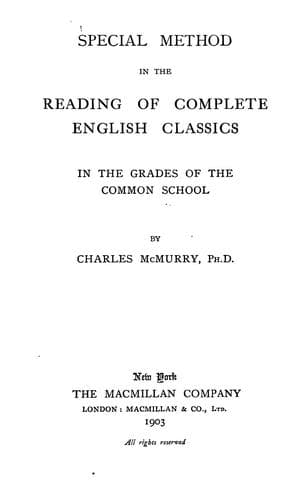
Special Method in the Reading of Complete English Classics: In the Grades of the Common SchoolMcMurry, Charles A. (Charles Alexander)
General
Special Method in the Reading of Complete English Classics: In the Grades of the Common School
McMurry, Charles A. (Charles Alexander)
American literature -- Study and teaching; English literature -- Study and teaching
We have already discussed the moral value of the right books for
children. The lessons of the great works are so profound in this respect
that they offer a still wider range of study to the teacher. Even the
foremost thinkers and philosophers have found therein an inexhaustible
source of truth and wisdom.
In the Foreword to his "Great Books as Life Teachers," Newell Dwight
Hillis says, "For some reason our generation has closed its text-books
on ethics and morals, and opened the great poems, essays, and novels."
This is a remarkable statement and is the key-note to a silent but
sweeping change in education. He adds, "Doubtless for thoughtful persons
this fact argues, not a decline of interest in the fundamental
principles of right living, but a desire to study these principles as
they are made flesh and embodied in living persons." Again, "It seems
important to remember that the great novelists are consciously or
unconsciously teachers of morals, while the most fascinating essays and
poems are essentially books of aspiration and spiritual culture."
It is suggestive to note that this fundamental text is worked out in his
book by chapters on Ruskin's "Seven Lamps of Architecture," George
Eliot's "Romola," Hawthorne's "Scarlet Letter," Victor Hugo's "Les
Miserables," Tennyson's "Idylls of the King," and Browning's "Saul."
This suggests a fruitful line of studies for every teacher.
Among modern essayists, Emerson, Carlyle, Ruskin, and Matthew Arnold
stand preëminent, and they are already well established among the
mightiest teachers of our age, and it may be, of many to come. Sure it
is that teachers could not do better than put themselves within earshot
of these resonant voices. Their heart-strings will vibrate and their
intellects will be stretched to a full tension, not simply by the music,
but by the truth which surges up and bursts into utterance. It is
scarcely a figure of speech to say that the lightning flashes across
their pages. The stinging rebuke of wrong, the noble ideals of
righteousness, place them among the prophets whose tongues have been
touched with fire from the altar.
Besides the historical, social, and moral tuition for teachers in
literature, there are several other important culture effects in it. The
deepest religious incentives are touched, nature in her myriad phases is
observed with the eye of the poet and scientist, and the æsthetic side
of poetry and rhythmic prose, its charm and graces of style, its music
and eloquence, work their influence upon the reader. Literature is a
harp of many strings, and happy is that teacher who has learned to
detect its tones and overtones, who has listened with pleasure to its
varied raptures, and has felt that expansion of soul which it produces.
Public-domain text, read in full here on John Shaqi.
Reviews
Reviews
No reviews yet
Be the first to share your thoughts on this work.
Elsewhere in the archive
Join the Discussion
Join the discussion
Sign in to leave a comment or review.
Sign InorCreate an account