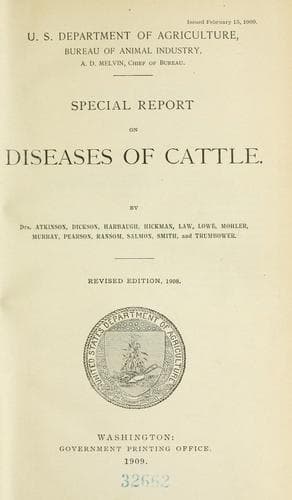
Special report on diseases of cattleUnited States. Bureau of Animal Industry
Science
Special report on diseases of cattle
United States. Bureau of Animal Industry
Cattle -- Diseases
Constipation is to be regarded rather as a symptom of disease or of faults
in feeding than as a disease in itself. It occurs in almost all general
fevers unless the bowels are involved in local disease, in obstructions of
all kinds, from feeding on dry, bulky feed, etc. In order to remove the
constipation the treatment must be applied to remove the causes which give
rise to it. Calves sometimes suffer from constipation immediately after
birth when the meconium that accumulates in the bowels before birth is not
passed. In such cases, give a rectal injection of warm water and an ounce
of castor oil shaken up with an ounce of new milk. The mother's milk is the
best food to prevent constipation in the new-born calf, as it contains a
large amount of fatty matter which renders it laxative in its effects.
It is usually better to treat habitual constipation by a change of diet
than by medicine. Flaxseed is a good feed laxative. If the constipation has
lasted long, repeated small doses of purgatives are better than a single
large dose.
INTESTINAL WORMS.
[See chapter on "The animal parasites of cattle," p. 502.]
RUPTURES (VENTRAL HERNIA).
Ventral hernia, or rupture, is an escape of some one of the abdominal
organs through a rupture in the abdominal muscles, the skin remaining
intact. The rumen, the small intestine, or part of the large intestine, and
the fourth stomach are the parts which usually form a ventral hernia in
bovine animals.
_Causes._--Hernia is frequently produced by blows of the horns, kicks, and
falls. In old cows hernia may sometimes occur without any direct injury.
HERNIA OF THE RUMEN.--Hernia of the rumen is generally situated on the left
side of the abdomen, on account of the situation of the rumen. In
exceptional cases it may take place on the right side, and in such cases it
also generally happens that some folds of the intestine pass into the
hernial sac. Hernias have been classified into simple or complicated,
recent or old, traumatic (from mechanical injury) or spontaneous.
In recent traumatic hernia there is swelling on the left side of the lower
part of the abdomen. The swelling is greatest in the cases of hernia which
are situated on the lower part of the abdomen. Unless an examination is
made immediately after the injury has been inflicted it is difficult, and
sometimes impossible, to ascertain the exact extent of the rupture, owing
to the swelling which subsequently takes place. Frequently there is no loss
of appetite, fever, or other general symptoms attending the injury. From
the twelfth to the fifteenth day the swelling has generally subsided to
such an extent that it is possible by an examination to determine the
extent of the rupture.
Public-domain text, read in full here on John Shaqi.
Reviews
Reviews
No reviews yet
Be the first to share your thoughts on this work.
Join the Discussion
Join the discussion
Sign in to leave a comment or review.
Sign InorCreate an account