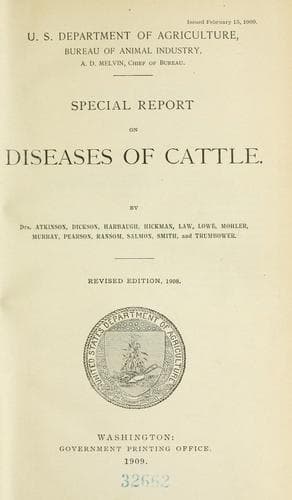
Special report on diseases of cattleUnited States. Bureau of Animal Industry
Science
Special report on diseases of cattle
United States. Bureau of Animal Industry
Cattle -- Diseases
In old cows what is termed spontaneous hernia may sometimes take place
without any direct injury. The occurrence of this form of hernia is
explained by the increase in the size of the abdomen, which takes place in
an advanced stage of pregnancy, causing a thinning and stretching of the
muscular fibers, which at last may rupture, or give way. Such hernias
frequently occur about the end of the period of gestation, and in some
instances have contained the right sac of the rumen, the omentum, the small
and large intestines, a portion of the liver, and the pregnant uterus.
In old hernias the swelling is soft and elastic, and if they have not
contracted adhesions to the sides of the laceration, they can be made to
disappear by pressure carefully applied. Sometimes this accident is
complicated by a rupture of the rumen, constituting a complicated hernia.
If a portion of the contents of the rumen escape into the abdomen, the case
will be aggravated by the occurrence of peritonitis.
HERNIA OF THE BOWEL.--When the intestines (Pl. III, fig. 6) form the
contents of the hernia, it will be situated at the right side of the
abdomen. In an intestinal hernia the swelling is usually not painful, of a
doughy consistence or elastic, according as the intestine does or does not
contain alimentary matter. This swelling can generally be made to disappear
by pressure, and when it has been reduced one can easily recognize the
direction and extent of the hernial opening. Hernias of the bowel which are
situated at the upper and right side of the abdomen are usually formed by
the small intestine. They are less easily reduced than a hernia in a lower
situation, but when reduction has been effected they are less readily
reproduced than those occurring lower. In hernias of the small intestine,
adhesion of the protruding parts to the walls of the opening, or
strangulation, are complications which sometimes take place. If adhesion
has taken place the hernia can not be reduced by pressure, and when
strangulation has occurred the animal shows symptoms of pain--is restless,
turns its nose to the painful part, and shows those symptoms which are
usually collectively designated under the term colic. If relief is not
afforded, the animal will die.
HERNIA OF THE RENNET, OR FOURTH STOMACH.--This disease occasionally occurs
in calves and is usually caused by a blow from a cow's horn on the right
flank of the calf. After such an accident a swelling forms on the right
flank near the last rib. This swelling may be neither hot nor painful, even
at first, and is soft to the touch. It can be made to disappear by careful
pressure, when the sides of the aperture through which it has passed can be
felt. The application of pressure so as to cause the disappearance of the
hernia is best made immediately after the occurrence of the accident, or
when the edema which accompanies the swelling has disappeared.
Public-domain text, read in full here on John Shaqi.
Reviews
Reviews
No reviews yet
Be the first to share your thoughts on this work.
Join the Discussion
Join the discussion
Sign in to leave a comment or review.
Sign InorCreate an account