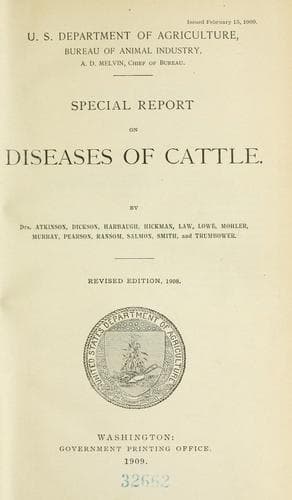
Special report on diseases of cattleUnited States. Bureau of Animal Industry
Science
Special report on diseases of cattle
United States. Bureau of Animal Industry
Cattle -- Diseases
To define clearly the meaning of the word "poison" is somewhat difficult.
Even in law the word has never been defined, and when a definition is
attempted we are apt to include either too much or too little. The
following definition given by Husemann is perhaps the best: "Poisons are
those substances, inorganic or organic, existing in the organism or
introduced from the outside, produced artificially or formed as natural
products, which, through their chemical nature, under definite conditions,
so affect some organ of a living organism that the health or well-being of
the organism is temporarily or chronically injured." The common conception
of a poison is any substance which, in small quantity, will destroy life,
except such as act by purely mechanical means, as, for example, powdered
glass.
Some substances that are not usually looked upon as poisons may destroy
life if given in large doses, such as common salt. Other substances which
are perfectly harmless when taken into the body in the usual way are
poisons if injected into the circulation, such as distilled water, milk, or
glycerin. Living organisms are not "chemical substances," and are not
considered in this connection.
SOURCES OF POISONING.
Poisoning may come from many causes, among the chief of which are the
following:
(1) _Errors in medication._--By using the wrong substance or too large dose
an animal may be poisoned.
(2) _The exposure of poisons used for horticultural, technical, or other
legitimate purposes._--Poisons used for spraying plants, disinfecting,
poisoning vermin, dipping cattle or sheep, painting, smelting, dyeing, or
other purposes may be so handled as to come within the reach of animals.
(3) _Damaged food._--Food that has undergone putrefaction or certain kinds
of fermentation or heating, may have become poisonous, producing forage
poisoning, meat poisoning, cheese poisoning, etc.
(4) _Poisonous plants in the pasture or forage._
(5) _The bite or sting of a poisonous insect or the bite of an animal._
(6) _Malicious poisoning._
THE ACTION OF POISONS.
Public-domain text, read in full here on John Shaqi.
Reviews
Reviews
No reviews yet
Be the first to share your thoughts on this work.
Join the Discussion
Join the discussion
Sign in to leave a comment or review.
Sign InorCreate an account