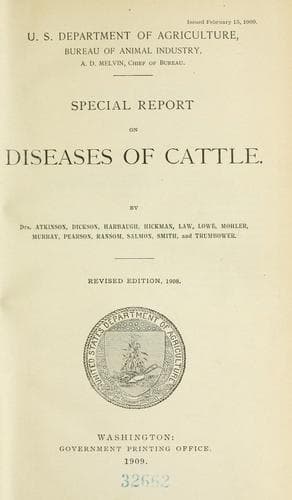
Special report on diseases of cattleUnited States. Bureau of Animal Industry
Science
Special report on diseases of cattle
United States. Bureau of Animal Industry
Cattle -- Diseases
The action of poisons may be either local, and exerted directly on the
tissues with which they come in contact, or remote, acting through the
circulation or the nervous system; or both local and remote action may be
exerted by the same drug. Poisons which act locally generally either
destroy by corrosion the tissues with which they come in contact or by
inhalation set up acute inflammation. When any corrosive agent is taken
into the stomach in poisonous quantities, a group of symptoms is developed
which is common to all. The tissues with which the agent comes in contact
are destroyed, sloughing and acute inflammation of the surrounding
structures take place; intense pain in the abdomen and death ensue. In a
like manner, but with less rapidity, the same result is reached if the
agent used be not of a sufficiently corrosive nature to destroy the
tissues, but sufficiently irritating to set up acute inflammation of the
mucous membrane of the digestive tract. If the poison exerts a remote
influence alone, the action is quite different, little or no local effect
being produced upon the digestive organs.
To produce an effect on some part of the body distant from the channel of
entrance, a poison must have been absorbed and carried in the blood to the
central nervous system or other region involved. The poisonous effect of
any substance is modified by the quantity used; by its chemical
combinations; by the part of the animal structure with which it comes in
contact; by the physical condition of the subject; and also by the rapidity
with which the poison is excreted. As an illustration, opium may be given
with safety in much larger doses to an animal suffering from acute pain
than to one free from pain, and to an adult animal with greater safety than
to a young one. The rapidity with which the poison is absorbed, owing to
the part of the body with which it is brought in contact, is also an
important factor. So marked is this quality that some agents which have the
power of destroying life with almost absolute certainty when introduced
beneath the skin, may be taken into the stomach without causing
inconvenience, as curara, the arrow poisons, or the venomous secretion of
snakes. Other agents in chemical combination may tend to intensify, lessen,
or wholly neutralize the poisonous effect. For example, arsenic in itself
has well-marked poisonous properties, but when brought in contact with
dialyzed iron it forms an insoluble compound and becomes innocuous.
Idiosyncrasies are not so noticeable in cattle practice as in practice
among human beings, but the uncertainty with which some drugs exert their
influence would lead us to believe that well-marked differences in
susceptibility exist. Even in some cases a tolerance for poison is
engendered, so that in a herd of animals equally exposed injurious or fatal
effects do not appear with uniformity. For example, among cattle that are
compelled to drink water holding in solution a salt of lead the effects of
Public-domain text, read in full here on John Shaqi.
Reviews
Reviews
No reviews yet
Be the first to share your thoughts on this work.
Join the Discussion
Join the discussion
Sign in to leave a comment or review.
Sign InorCreate an account