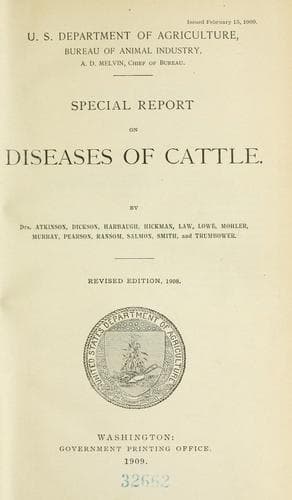
Special report on diseases of cattleUnited States. Bureau of Animal Industry
Science
Special report on diseases of cattle
United States. Bureau of Animal Industry
Cattle -- Diseases
Of the common irritant and corrosive poisons, arsenic, especially one of
its compounds (Paris green), is likely to be the most dangerous to our
class of patients. The common practice of using Paris green and other
compounds of arsenic as insecticides for the destruction of potato beetle
and other insect enemies of the farmer and fruit grower has had the effect
of introducing it into almost all farming establishments. White arsenic is
also a principal ingredient in some popular dipping preparations, and
poisoning from this source occasionally takes place when, after dipping,
animals are allowed to run in a yard in which there is loose fodder. The
drippings from the animals falling on the fodder render it poisonous and
dangerous to animal life if eaten. Familiarity with its use has in many
instances tended to breed contempt for its potency as a poison. Rat poisons
often contain arsenic. The excessive use of arsenic as a tonic, or of
"condition powders" containing arsenic, has been the means of poisoning
many animals. This is the common poison used by malicious persons with
criminal intent. The poison may also be absorbed through wounds or through
the skin if used as a dip or bath.
If a large dose is given, at once acute poisoning is produced; if repeated
small doses are given, chronic poisoning may result. The poisonous dose for
an ox is from 3 drams to 1 ounce.
_Symptoms._--The symptoms of acute poisoning first appear as those of
colic; the animal is restless, stamping with the feet, lying down and
getting up. There is tenderness on pressure over the abdomen. The acute
symptoms increase; in a few hours violent diarrhea is developed; in many
cases blood and shreds of detached mucous membrane are mixed with the
evacuations. There is irregular and feeble pulse and respiration, and death
is likely to supervene between the eighteenth hour and the third day. If
the latter period is passed, there is a reasonable hope of recovery.
In chronic poisoning the symptoms are similar to those of chronic
gastrointestinal catarrh, with indigestion, diarrhea, and general weakness
and loss of condition.
_Treatment._--The antidote for arsenic is a solution of hydrated oxid of
iron in water. It should be prepared fresh by mixing a solution of sulphate
of iron, made by dissolving 4 ounces of sulphate of iron in one-half pint
water, with a suspension of 1 ounce of magnesia in one-half pint water.
This quantity is sufficient for one dose for a cow and may be repeated in
an hour, if much arsenic was taken. A solution of calcined magnesia or
powdered iron or iron filings or iron scale from a blacksmith's forge may
be given in the absence of other remedies. Powdered sulphur is of some
value as an antidote. One must also administer protectives, such as linseed
tea, barley water, whites of eggs, etc.
LEAD POISONING.
Public-domain text, read in full here on John Shaqi.
Reviews
Reviews
No reviews yet
Be the first to share your thoughts on this work.
Join the Discussion
Join the discussion
Sign in to leave a comment or review.
Sign InorCreate an account