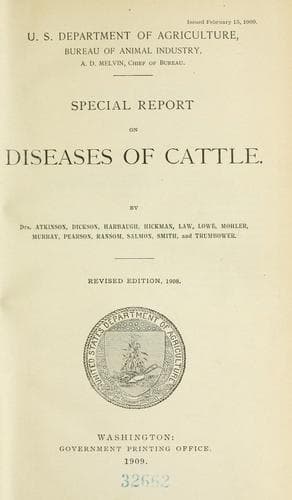
Special report on diseases of cattleUnited States. Bureau of Animal Industry
Science
Special report on diseases of cattle
United States. Bureau of Animal Industry
Cattle -- Diseases
The treatment of animals suffering from poison must vary according to the
nature of the toxic agent. There are a few general plans of action,
however, which should be followed so far as possible. In man and in some of
the smaller animals it is possible to eliminate unabsorbed poison by the
use of the stomach pump or by causing vomiting. These proceedings are
impracticable in cattle. It is well, therefore, in many cases to endeavor
to expel the unabsorbed poison by emptying the digestive tract, so far as
may be, with a nonirritating purge. Castor oil in doses of 1 pint to 2
quarts is adapted to this purpose. If the poison is known to be
nonirritant--as a narcotic plant--from 10 to 20 drops of croton oil may be
given with a quart of castor oil. When poisons are somewhat prolonged in
their effect, Epsom salt in doses of 1 pound can be given advantageously.
To protect the mucous membrane from the action of strong irritants, one may
give flaxseed tea, barley water, the whites of eggs, milk, butter, olive
oil, or fresh lard. Chemical antidotes may sometimes be used for special
poisons, as advised below. In general, if an acid has been taken it may be
neutralized with an alkali, such as chalk, magnesia, bicarbonate of soda
(baking soda), ammonia (diluted), or soap. If the poison is an alkali, such
as caustic soda or potash (lye), or ammonia, an acid, such as diluted (1
per cent) sulphuric acid or vinegar, may be administered. Special
treatments and antidotes are considered below.
A poisonous agent may be so gradually introduced into the system as to
slowly develop the power of resistance against its own action. In other
cases where the poison is introduced slowly the poisonous action becomes
accumulative, and, although there is no increase in the quantity taken,
violent symptoms are suddenly developed, as if the whole amount, the
consumption of which may have extended over a considerable period, had been
given in one dose. Other agents, poisonous in their nature, tend to
deteriorate some of the important organs, and, interfering with their
natural functions, are productive of conditions of ill health which,
although not necessarily fatal, are important. Such might properly be
called chronic poisons. Poisons of themselves dangerous when administered
in large doses are used medicinally for curative purposes, and a very large
percentage of the pharmaceutical preparations used in the practice of
medicine if given in excessive quantities may produce serious results. In
the administration of medicines, therefore, care should be exercised not
only that the animal is not poisoned by the administration of an excessive
dose but that injury is not done by continued treatment with medicines the
administration of which is not called for.
MINERAL POISONS.
ARSENIC POISONING.
Public-domain text, read in full here on John Shaqi.
Reviews
Reviews
No reviews yet
Be the first to share your thoughts on this work.
Join the Discussion
Join the discussion
Sign in to leave a comment or review.
Sign InorCreate an account