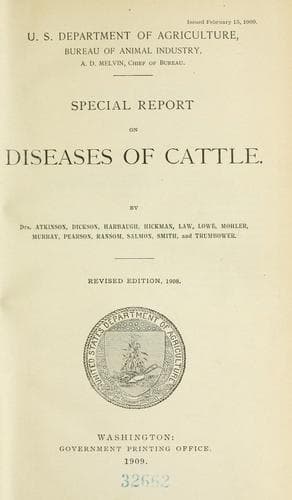
Special report on diseases of cattleUnited States. Bureau of Animal Industry
Science
Special report on diseases of cattle
United States. Bureau of Animal Industry
Cattle -- Diseases
LARKSPURS.
The larkspurs are a source of heavy loss to cattle owners in the higher
ranges of the West. There are a number of species, growing at altitudes
from 4,000 feet to timber line, and all are poisonous. A few cases of
poisoning by larkspurs have been reported in the eastern United States, but
most of the losses are confined to the West, both because larkspurs grow
there in greater profusion and because cattle are grazed in that region on
the open ranges. The losses are confined to cattle, for sheep and horses
can graze on larkspur with no resulting harm. Most of the larkspur losses
occur in the spring and early summer, as the plants lose their toxicity
after maturing.
_Symptoms._--Larkspur poisoning is accompanied by a definite line of
symptoms. In range animals the first symptom noted is generally the sudden
falling of the animal and consequent inability to rise. After a while it
may rise, only to fall again. This may happen repeatedly. In severe cases
the animal lies prone and exhibits nausea, accompanied by vomiting. It dies
of respiratory paralysis, death many times being hastened by the asphyxia
following the vomiting.
_Treatment._--The animal, if found down, should be turned so that its head
is uphill in order to relieve the lungs. Many cases will recover with no
further treatment. Nearly all cases will recover if a hypodermic injection
is given immediately of physostigmin salicylate 1 grain, pilocarpin
hydrochlorid 2 grains, strychnin sulphate 1/2 grain.
LOCO.
The loco plants have caused especially heavy losses of cattle, horses, and
sheep. They grow in the semiarid regions of the West and sometimes in great
luxuriance. The best known are the "blue loco," the "woolly loco" or
"purple loco," and the "white loco" or "rattle-weed." The blue loco is
common in parts of New Mexico, Arizona, and Utah. It affects both horses
and cattle. The purple loco, _Astragalus mollissimus_, is common in Texas
and the adjoining States and extends north as far as Nebraska and Colorado.
It is especially destructive to horses. The white loco, _Oxytropis
lamberti_, is still more widely distributed, being found in the plains
region from Alaska to Mexico and west of the Rocky Mountains to central
Utah. The white loco is much more important than the purple loco, for it
affects not only horses but cattle and sheep. These plants belong to the
pea family, and there are a number of other species of this family that are
loco plants and produce the same symptoms.
Public-domain text, read in full here on John Shaqi.
Reviews
Reviews
No reviews yet
Be the first to share your thoughts on this work.
Elsewhere in the archive
Join the Discussion
Join the discussion
Sign in to leave a comment or review.
Sign InorCreate an account