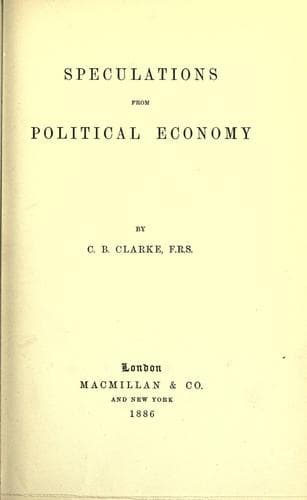
Speculations from Political EconomyClarke, Charles Baron
General
Speculations from Political Economy
Clarke, Charles Baron
Economics
The ideas of Reciprocity and Retaliation are pure relics of the old
Protectionist commercial theory, viz. that there is always a national
loss in parting with gold--that the foreign trade can only be profitable
to England so long as the value of the exports exceeds that of the
imports, so that a continual accumulation of gold may go on.
Now, first, we may meet this with the abstract scientific argument that
there is no character by which gold can be diagnosed as wealth from
steel or broadcloth. Our merchant who buys wheat for gold could buy from
the Americans wheat for cutlery or wheat for broadcloth. The reason he
gives gold for the wheat is merely because he makes a better profit by
giving gold than by giving anything else in exchange for the wheat. The
nation therefore gets a better profit that way too.
Descending a little from this abstract argument, our opponent says,
"If you go on buying wheat for gold, and cannot sell your cutlery and
broadcloth out of the country for gold, you _must_ run out of gold."
But the fact has been proved by many years' experience not so to be: for
many years our imports have been some £150,000,000 sterling more than
our exports, while our stock of gold in the Bank of England (and the
gold in circulation) remain the same from year to year. This is one
of those many things (like the supply of meat to London) which
will regulate itself perfectly and insensibly (without any violent
disturbances in trade or the money market) if Government will only leave
the matter entirely alone. If our stock of gold is at all short our
merchants give a little less per quarter for American wheat; the
trade is checked; the sensibility of the market--the experience of our
corn-traders--is such that the balance is preserved with very slight
oscillations. The refusal of the Americans (enforced by an import duty)
to purchase our cutlery, etc., _does_ partially check the reflux of gold
to this country, and does lower sensibly the price which the Americans
get for their wheat from us. Errors in political economy avenge
themselves--often fearfully--on their perpetrators. But our objector
will still want to have explained to him where the £150,000,000 sterling
required in England annually comes from. It is not essential to, or
indeed any part of, my present argument to explain this; but I will
anticipate matters so far as to say shortly here that this £150,000,000
is, roughly speaking, the interest on English capital invested in
foreign countries paid in cash to the owners resident in England--it is
equivalent to an annual tribute.
Public-domain text, read in full here on John Shaqi.
Reviews
Reviews
No reviews yet
Be the first to share your thoughts on this work.
Join the Discussion
Join the discussion
Sign in to leave a comment or review.
Sign InorCreate an account