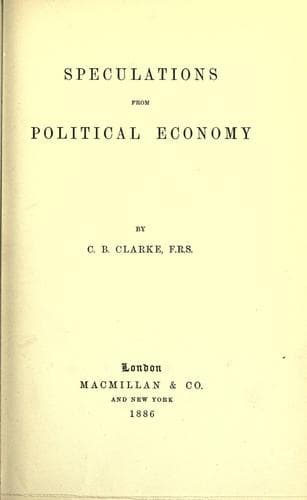
Speculations from Political EconomyClarke, Charles Baron
General
Speculations from Political Economy
Clarke, Charles Baron
Economics
It is perfectly true that if my neighbour in Threadneedle Street does
succeed in selling £2000 worth of cutlery to the New Englander, there is
another distinct national profit to England and to America. [Footnote:
I am assuming for simplicity throughout that every exchange made by
private merchants in this foreign trade is a successful speculation; if
in any particular speculation a merchant loses, his country loses the
same amount. As foreign trade, on the whole, is an enormous national
profit, I am justified in sinking the particular cases of loss. It may
be said, "But perhaps all your exchange of gold for wheat is a national
loss": it is evident that when the trade takes this form the merchants
who import foreign corn stop their operations instantly; in practice
they stop them with prescient instinct.] But whether he succeeds
in making a bargain or not, I object to being interfered with by
Government, and prevented making my own little profit. If my neighbour
is practically deprived of his profitable bargain by Government action
on the part of the Americans--if they are Protectionists and believe
that gold is the only National Wealth, and put a heavy duty on
cutlery--if by doing this they prevent an exchange profitable to both
nations--they stop TWO merchants from a profitable stroke of business.
Whether they injure the English merchant or the Bostonian would-be
purchaser of cutlery MOST is (as above explained) very difficult to
prove in any well-ascertained instance, but it is quite certain that the
interference of the American import duty causes a loss to each merchant
and to each nation.
Where now is Reciprocity and where Retaliation? We can no doubt say to
the Americans, "As you have injured us in the matter of cutlery, so will
we injure you by putting a duty on wheat." But it is merely cutting off
one's nose to spite one's face. In the exchange of gold for wheat the
division of the profit on one transaction is uncertain, but in the long
run it is probably about equal between the English and the American
merchants, i.e. between the English and the American nations. (I am
not overlooking the fact that the ultimate benefit to England is cheap
bread; but it is unnecessary in the present argument to follow the food
down the throats of the consumers: the wheat is really worth to the corn
merchants what they can get for it from the consumers.) We cannot stop
the corn trade with America by a duty (or diminish it) without as great
a loss to ourselves (probably a greater) than to them; the retaliation
in putting a duty on corn because the Americans put a duty on cutlery
would be (with our lights) mere spite: it would be as though a farmer
who took one sample of wheat to market and one of barley, should meet a
factor who offered him his price for the wheat, but would not spring to
his price for the barley, and the farmer should thereupon sulkily carry
both his samples home again.
Public-domain text, read in full here on John Shaqi.
Reviews
Reviews
No reviews yet
Be the first to share your thoughts on this work.
Join the Discussion
Join the discussion
Sign in to leave a comment or review.
Sign InorCreate an account