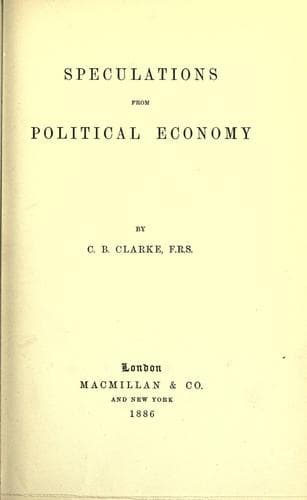
Speculations from Political EconomyClarke, Charles Baron
General
Speculations from Political Economy
Clarke, Charles Baron
Economics
Ricardo, at the end of his masterly consideration of the effect of
taxation variously levied, comes to the general conclusion that the
best tax is that which is least in amount. Adam Smith and the older
economists held that one test which a well-devised tax had to satisfy
was that it should take the money from the taxpayer insensibly,
indirectly. Now, all taxes that thus insensibly drain the taxpayers
invariably take more in gross from them than reaches the Government. To
raise £40,000,000 by customs and excise costs about £3,000,000; so
that the people have to pay £43,000,000, while the Government gets
£40,000,000. In direct taxes, as income taxes, property rates, the cost
of collection is very small--about two-pence in the pound. In public
as in private business it is much more economic to look payments in the
face and make them with our eyes open than to let the money slip away
in driblets. Moreover, modern politicians think, in opposition to Adam
Smith, that it has a good moral effect on the body politic to be made
to feel exactly what taxes they pay, so that they cannot help knowing
whenever taxation is increased.
A serious objection to indirect taxation is that it always falls with
unfair weight on the poor, as in the case of tea duties stated above.
It may be urged that the existing duties are (except tea) nearly all on
luxuries, as beer, spirits, tobacco. But the English have drunk beer for
many hundred years; the taste for beer is largely fixed by inheritance;
beer as supplying sustenance in a form that _rapidly_ assists exhausted
nature is, to very many at least, as much a necessary of life as tea is.
Whether we believe tobacco to be injurious or not, we have no right to
impose on an article so very largely consumed a duty which amounts to
taxing the poor out of proportion to the rich.
If all the indirect taxes are removed, the poor (at least down to those
earning £1 a week and upwards) must be made to contribute to direct
taxes. It may be urged against Universal Free Trade that the poor are
so ignorant that they would sooner pay sixteen-pence a week in taxes
indirectly than eightpence directly. This might prove a fatal objection
to carrying out Universal Free Trade at the first attempt; but one of
the objects to be gained by direct taxation is the education of the
people. It may also be urged that the whole political power being now in
the hands of the masses, they are so selfish and unjust that if taxation
is made a plain matter they will put all taxation on the rich and
refuse to pay anything themselves. The reply to this is, If this is your
estimate of the understanding and morality of the masses, you should not
have put the whole political power in their hands.
Public-domain text, read in full here on John Shaqi.
Reviews
Reviews
No reviews yet
Be the first to share your thoughts on this work.
Join the Discussion
Join the discussion
Sign in to leave a comment or review.
Sign InorCreate an account