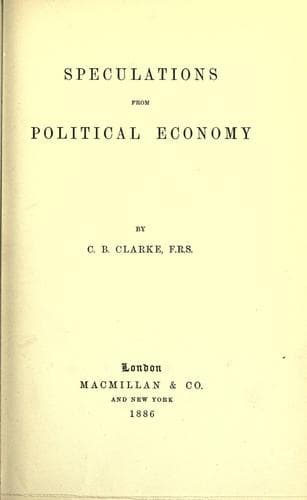
Speculations from Political EconomyClarke, Charles Baron
General
Speculations from Political Economy
Clarke, Charles Baron
Economics
We are only attempting at present to show that the £40,000,000 sterling
(to replace duties and those parts of the excise which hang on duties)
_could_ be raised by direct taxation: we are not attempting to show
the best way it could be raised by direct taxation; it will be seen
hereafter that a portion of it might perhaps be better raised by a
National Property Rate.
The £40,000,000 would be raised by an income tax of sixteen-pence in the
pound--(I am underestimating safely--about a shilling in the pound would
raise it really),--carried down to £156 a year without any reductions;
while incomes of £1 a week paid eightpence weekly, and incomes of £2 a
week paid twelvepence weekly. In the Crimean War the nation endured an
income tax of sixteen-pence in the pound; it is certain that the nation
is richer now, and better able to bear such a rate.
But this is not the strength of the argument. In the Crimean War England
endured sixteen-pence in the pound _extra_, in addition to all existing
taxes (some of which were raised too), and the capital thus taken from
the people was destroyed (much of it) or dissipated in the Crimea. But
the sixteen-pence in the pound here suggested would be in lieu of an
equal amount of taxes taken off (it would be rather less in amount than
the taxes taken off): the nation therefore, would not feel it at all,
though individuals would feel it in different ways. A poor man would
have eightpence a week deducted from his wages, but he would get his
beer at three-fifths the present price, his tea at two-thirds the
present price, etc. He would soon feel that he gained by the change. The
rich would find that they lost; but that loss would, I believe, be made
up to them over and over again.
First, I believe it is impossible to realise the effect on our trade of
having London, Liverpool, etc., free ports. We possess at present half
the ocean trade of the world: with our ports free, we should get a yet
larger share of the world's trade, and secure it permanently. That is to
say, we should certainly keep it until other nations adopted Universal
Free Trade.
Secondly, The fall in the price of tea, beer, etc., would be more than
the amount of the tax remitted: the freedom of universal manufacture
without any Government interference, the liberty to land tea without
delay, and put it into the market without having to advance the duty,
would cause at once a great activity in the trades, and at the same time
a fall in price. By diminishing the need for middle-men the quality of
the beer, tea, etc., would be raised, and adulteration diminished.
Public-domain text, read in full here on John Shaqi.
Reviews
Reviews
No reviews yet
Be the first to share your thoughts on this work.
Join the Discussion
Join the discussion
Sign in to leave a comment or review.
Sign InorCreate an account