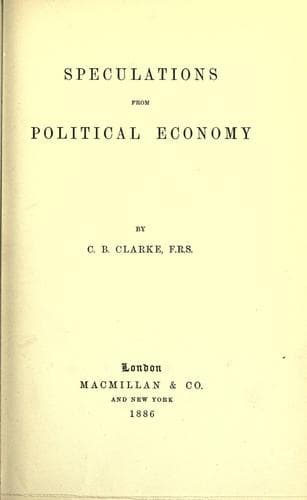
Speculations from Political EconomyClarke, Charles Baron
General
Speculations from Political Economy
Clarke, Charles Baron
Economics
them: to put any heavy ransom on the land would at once throw large
areas in England out of cultivation.
The question of the ransom, therefore, is not so all-important as has
been considered; the rates at present being £25,000,000, it might be
possible to levy an additional national rate of £5,000,000 to keep down
the perpetually upspringing rights of new-born infants, without throwing
land out of cultivation to any sensible extent. The whole question
will lie thus between a total rate of £25,000,000 and £30,000,000. I
am about, however, as a corollary to this subject, to suggest a way of
forming a National Rate Book which probably would not materially alter
the present rating, but which would alter entirely the taking of land
for public purposes, and would effectuate all that is good in the phrase
the Nationalisation of Land.
This phrase is liberally used but rarely defined. Different orators
appear to have quite different ideas as to what it means; and when they
explain what they suppose it to mean, they generally prove that, in the
way they understand it, it would be serious national damage.
It is unnecessary to observe that landlords now (omitting individual
exceptions and idiosyncrasies) expend their best endeavours in getting
the best rent they can for their land. They have no prejudices in favour
of farms of a particular size; a landlord of a farm of 1000 acres would
let it directly in five-acre plots if he could get a better (and equally
certain) gross rent by so doing. "Nationalisation" is often taken to
mean that Government is to buy land and let it out in small plots. But
apart from expense of Government management and objections to Government
interference, we may safely assume that there would be a national loss
by this procedure: the private owner would discover very quickly if he
could make a profit by letting his farms piecemeal.
All Government interference can do to improve the produce of the land is
to abolish all restrictive laws, and to make the general tenure of land
such that every piece of land shall fall into the hands of that man who
is able to make the most of it. The National Rate Book now suggested is
designed to accomplish this end. We will subsequently consider how
it might assist public companies. As the suggested way of getting a
National Rate Book is at first sight rather startling, I would premise
that it is no rash invention of mine; it worked admirably in Attica--as
see Demosthenes or Boeckh.
To make the National Rate Book, each landowner values (with the
magistrate) his land at what price he pleases; the State has the right
to buy the land at any time at that price, plus 33-1/3 per cent for
compulsory purchase. The magistrate sees that each separate house, farm,
and plot is valued separately. No person need prove his title; any man
can value any piece of land, and need not prove himself to be owner,
tenant, or agent; but any piece of land valued by no one would be
claimed as public property.
Public-domain text, read in full here on John Shaqi.
Reviews
Reviews
No reviews yet
Be the first to share your thoughts on this work.
Join the Discussion
Join the discussion
Sign in to leave a comment or review.
Sign InorCreate an account