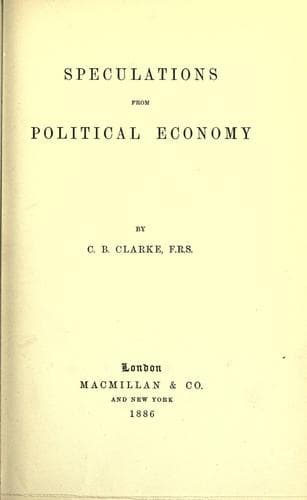
Speculations from Political EconomyClarke, Charles Baron
General
Speculations from Political Economy
Clarke, Charles Baron
Economics
Lastly, It has not been overlooked that there is an income tax now: and
if the whole proceeds of the sixteen-pence income tax were used to
fill up the deficiency in customs and excise, then we have to make up a
deficiency equal to the present proceeds of the income tax. This
might be done (to start with) by the National Property Rate now to be
suggested. But the expectation is, that with Universal Free Trade, and
the tremendous stimulus thereby given to commerce and manufacture, the
National Income would rise with a bound, and that in two or three years
a much lower rate than sixteen-pence income tax in the pound would
supply the amount of all the indirect taxes abandoned.
4. THE RANSOM OF THE LAND.
Many people see quite clearly that, the population of England being
25,000,000, the next baby born has a right to one twenty-fifth-millionth
part of the area of England in soil of average fertility. The
arrangements of society by which the laud is partitioned among a limited
class, and the complicated rights sanctioned by law in one plot of
land, are considered of no validity as against the natural right of the
new-born baby. I do not see this theory to be self-evident: on the other
hand the supporters of it always give it as fundamental, axiomatic; they
no doubt presume rightly that the land is limited, and that if one man
holds more than his arithmetical share, he must push out somebody
else from his arithmetical share: while a man who keeps a hundred
pocket-knives does not perceptibly hinder other people having numerous
pocket-knives. Still I do not see how this consideration weighs against
Lord Derby's title to his lands, if the body politic has determined that
on the whole it is best for the community that land should not be held
equally by all, and sanctions by law Lord Derby's monopoly of a large
area. On the theory of the natural right of every infant born to its
arithmetical share, the monopolisers of land are liable to a perpetually
recurring ransom: this can only practically be carried out by a special
National Rate on Real Property (_i.e._ Land, with the houses, mines,
etc., inseparably attached to it), which must be in addition to such
taxes as income tax, succession duty, etc., which land already suffers
equally with trades, professions, offices, and personalty. The local
rates in England exceed £25,000,000 annually; and the ratepayers perhaps
reckon this a large enough ransom. I should remark in passing that one
man with 1000 acres of land does not dispossess any more babies of their
rights than do ten men with 100 acres each. The ransom therefore must
be a strictly level rate: to put a higher rate on large holders, or to
despoil large holders of a portion of their landed property, will be to
work the ransom unfairly. It hence will follow that any heavy ransom is
now impracticable. Of late years some farms have gone out of cultivation
because they will not pay the tithe, land tax, and rates already on
Public-domain text, read in full here on John Shaqi.
Reviews
Reviews
No reviews yet
Be the first to share your thoughts on this work.
Join the Discussion
Join the discussion
Sign in to leave a comment or review.
Sign InorCreate an account