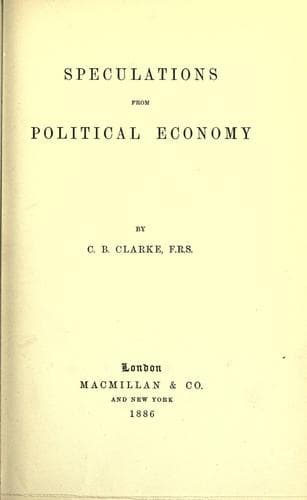
Speculations from Political EconomyClarke, Charles Baron
General
Speculations from Political Economy
Clarke, Charles Baron
Economics
It will be at once seen that this form of Rate Book would really
nationalise the land by bringing each piece into the hands of him who
could make most out of it. If I saw my way to use a piece of laud so
that it should be worth £1000 to me, and if on looking into the Rate
Book I saw that the present owner only considered it worth £600 to him,
I should at once lodge my £900 with the magistrate. A few owners would
really feel as Naboth. They could indulge this feeling by putting a very
high rateable value on their property. The high rates they would thus
have to pay would be the due ransom of the land; but in general every
piece of land would pass into the hands of him who could make most of
it. There would spring up, as in Attica, a large class of professional
sycophants. By their incessant operations, properties small and great
would be continually passing from the slothful and the old-fashioned
to the enterprising and modern-educated. No nationalisation of the land
could get so much out of it or conduce so highly to progress as the
National Rate Book. We should have companies and adventurers buying up
all sorts of pieces of land, just as formerly they speculated in taking
up land for mining in Cornwall. We should see an extraordinary activity
in the employment of capital in England.
For all public improvements, as a new street or a Government military
station, a few minutes with the map and Rate Book would show the
Government officer or engineer the best route or plot to take, and would
also show him the exact cost of the land for the scheme. There would be
no law expenses, no prolonged fights, no juries, no arbitrations.
Wastes, downs, heaths, bogs, would be rated very low. It would be in the
power of Government to take up largely and at small cost large areas
of Surrey heaths, etc., to provide air and recreation ground for
an evergrowing metropolis. In this manner, too, public commons and
quasi-public commons might be secured to the public all over England: a
public-spirited town-council or a local Kyrle Society would have a wide
field and an immense stimulus for action.
I have not stopped to rebut the common (but mistaken) idea that burdens
on the land (being in gross not more than the rackrent) affect the
cultivation. Partners have long drunk at market dinners "Confusion to
the black slug that devours the English farmer." How is it that these
farmers did not (do not) see that there are tithe-free farms (and some
tithe-free parishes) in England, and that the tenants of such farms get
no advantage by being tithe-free?
Public-domain text, read in full here on John Shaqi.
Reviews
Reviews
No reviews yet
Be the first to share your thoughts on this work.
Join the Discussion
Join the discussion
Sign in to leave a comment or review.
Sign InorCreate an account