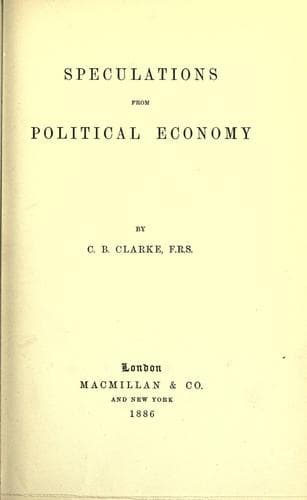
Speculations from Political EconomyClarke, Charles Baron
General
Speculations from Political Economy
Clarke, Charles Baron
Economics
As I explain elsewhere, a tenant with several years of his lease to
run is (economically considered) a part landowner: if the tithe were
suddenly abolished, tenants with leases would get relief as well as
their landlords. So if a new tax or rate is laid on land (and made
payable by the tenant), all tenants with leases will have to pay such
tax or rate out of their own pocket so long as their lease lasts;
afterwards it will fall wholly on the landlords.
It is repeated now, in nearly every country newspaper, that the English
farmer cannot compete with the American grower because of the burdens on
the land of England. I will not write out (I cannot improve) Ricardo's
proof that rent does not enter into price. The "burdens" on land are
really first charges on the rackrent and do not affect a year-to-year
tenant at all. When a farmer meditates taking a farm he asks not merely
what is the rent: he inquires what is the tithe, what the average amount
of the rates (and is that likely to increase or diminish during the next
seven years); the intending tenant only wants to know what sum in all
he will have to pay for the farm; whether any of this payment is called
tithe or not, or whether some of it is quit-rent, or whether he is to
pay the land tax for his landlord's convenience,--about all this he
cares nothing; they are mere questions of names to him.
5. MAKING THE MOST OF OUR LAND.
John S. Mill, following W. T. Thornton, advocated a system of petty
proprietors against the English system of large farms with hired
labourers. Figures were quoted to show the splendid produce got by petty
proprietors in France and elsewhere--as the result, however, of infinite
toil. The petty proprietors were, moreover, shown to be much better
off than our hired labourers; and the magic of property combined with
independence was represented as having produced a superior class.
These things may have been so, at least in some cases and particular
countries, at the date (before 1846) when J. S. Mill originally put
forward these views. The liberal, and radical writers on political
economy and sociology still follow (most of them) on the same side,
which has become in a manner historically the liberal side. There is
much against it.
Public-domain text, read in full here on John Shaqi.
Reviews
Reviews
No reviews yet
Be the first to share your thoughts on this work.
Join the Discussion
Join the discussion
Sign in to leave a comment or review.
Sign InorCreate an account