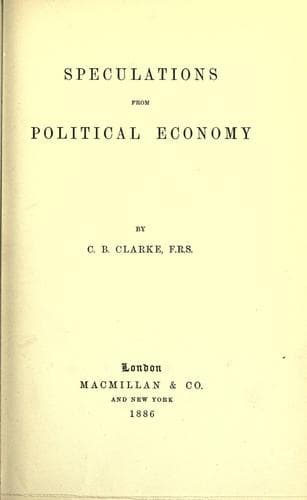
Speculations from Political EconomyClarke, Charles Baron
General
Speculations from Political Economy
Clarke, Charles Baron
Economics
First, Production on the large scale is cheaper than on the small; this
is as true of agriculture as of other industries. The large farmer
has one fixed and one movable steam-engine of his own; he has his own
drills, threshing and winnowing machines, reaping and mowing machines.
The petty proprietor may hire these, but at a dear rate, and few of them
can work to any advantage on his small patches of corn. The large farmer
has large fields; he saves area as against the petty proprietors; he has
fewer headlands and fences, harbouring weeds and stopping the sun and
air. The large farmer can work corn and sheep together; one shepherd and
his boy will look after 500 ewes. You may travel 200 miles by rail in
France and not see two flocks of sheep. Sheep-farming is seen all the
world over to be an industry that pays on the large scale; and the want
of it injures the corn produce of the French petty proprietor. Louis
Napoleon sent Lavergne to make a report on English farming; the
substance of his report is, that were France farmed on the English
system by English farmers, the corn produce would be four or five times
what it is now; leaving sheep out of the question.
The advocates of peasant-proprietorship, at least the better informed
ones, do not now suppose that a peasant receiving a few acres out of a
large English average farm (and capital to make a start) could make
a subsistence out of it. They believe that peasant-proprietors could
maintain themselves on small plots of rich land in and close to towns,
working as market-gardeners or cowkeepers rather than as farmers.
Public-domain text, read in full here on John Shaqi.
Reviews
Reviews
No reviews yet
Be the first to share your thoughts on this work.
Join the Discussion
Join the discussion
Sign in to leave a comment or review.
Sign InorCreate an account