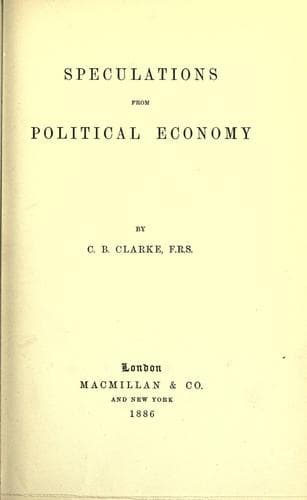
Speculations from Political EconomyClarke, Charles Baron
General
Speculations from Political Economy
Clarke, Charles Baron
Economics
It is very desirable that wealthy private philanthropic individuals and
wealthy private philosophic societies, should try experiments in small
farming, market-gardening, co-operative farming, reclamation of wastes,
etc. There is no hindrance to their so doing: they can readily hire as
many farms as they please at cheap rents, and subdivide them, and put in
picked labourers with an advance of capital. But that Government should
embark in uncertain speculations of this kind is quite another thing.
The safe general principle, whether in the sale of horses, the letting
of houses, or the letting of land, is that Government should not
interfere; or, to speak more correctly, Government interference should
only interfere to prevent restrictive covenants and to ensure Free
Trade, so that every article (land included) may pass without restraint
into the hands of the man to whom it is worth most. The greater the
individual profit the greater the national profit. Under a section
headed "Law," below, I will say something about the removal of entail,
etc.--a dry but important branch of the question. The National Property
Rate, with the aid of sycophants, would remove many obstructions.
There has been much controversy and several Parliamentary Acts
concerning the regulation of bargains between landlord and tenant. How
a tenant or a landlord can be injured in such a bargain is impossible
to understand, except in so far as a man is injured who gives £30 for
a horse worth only £20. Will Parliament interfere to protect such
horse-purchasers? The matter has been obscured by omitting to notice
that a tenant with a long lease at a fixed rent possesses a share
(often the larger share) of the "landlord interest," in the language of
political economy. As a simple example: A tenant took, say in 1850,
a Scotch farm on a Scotch lease absolute of nineteen years, at £500 a
year. Within two or three years of his so taking it the rise in wool,
potatoes, and other things, caused the value of the farm to rise to £600
a year, and this increased value lasted the whole of his lease and
some time after. Now, treating the increase of value of £100 a year as
permanent (as it was very soon regarded both by landlord and tenant),
it is clear that this £100 a year for the period of the lease (say
seventeen years to run) went to the tenant, not to the landlord; and the
first seventeen years of an annuity in fee is worth more than all the
rest.
Public-domain text, read in full here on John Shaqi.
Reviews
Reviews
No reviews yet
Be the first to share your thoughts on this work.
Join the Discussion
Join the discussion
Sign in to leave a comment or review.
Sign InorCreate an account