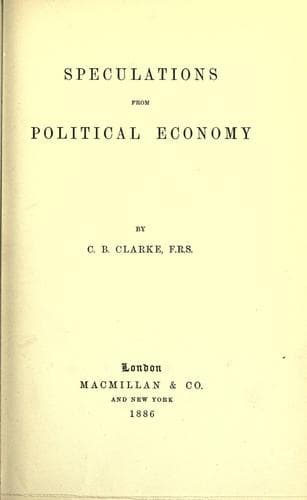
Speculations from Political EconomyClarke, Charles Baron
General
Speculations from Political Economy
Clarke, Charles Baron
Economics
It is evident that on a seven years' (absolute) lease the tenant would
similarly get a good share (not the larger share) in all the improvement
in value that occurred during his lease. Up to ten or twelve years ago
the value of land had been rising very steadily in the South of England
for near half a century. Rents were pushed up very generally at the
termination of every lease, though noblemen, great county gentlemen, the
Church, and the Universities, as a rule, never raised the rent on an old
tenant; but they could raise the rent all the more by a jump when a new
man came in. During all these years the tenant-farmers complained rarely
of their leases, though they were often subject to covenant nuisances
about cropping, selling off the farm, game, and incoming for the new
tenant.
But during the last ten years the process is reversed. A farmer took a
farm for £500 a year for seven years in the south of England, and before
the lease had run half out the farm was not worth £400 (and in many
cases not £300). Here the tenant suffered a heavy loss. When in former
years he got a gain he never proposed to allow his landlord 15 per
cent extra rent. But now that the drop in value of such farms has taken
place, and probably will not proceed further, a tenant who takes a
new lease requires no Act of Parliament to protect him: he can protect
himself. By the date the Abolition of the Game Laws (a wrong but
intelligible phrase) was carried, the farmers in the South of England
were in a position not to take any benefit under that Act, but to
covenant for all the game and sporting on their farms for themselves. So
as to the Act regulating the leases between tenant and landlord, where
they chose to avail themselves of it, the tenant now can generally get
more favourable terms outside the provisions of the Act. Farms are so
down, tenants so scarce, that landlords have to give way on all minor
points. Wherever Government interference operates at all, it is almost
sure to operate harmfully. Consider for a moment the case of "incoming."
Formerly, by the "custom of the country" south of London, the incoming
tenant paid for two years' dressing for the corn crops, north of London
he paid the outgoing tenant only for one year's dressing, by the custom
of the country too. The question practically only amounted to increasing
by 5 per cent the capital necessary to take the farm south of London.
Now what can be gained by Government interference in such a matter as
this, in which each farmer and land-agent was in general in favour of
the "custom" he had grown up under?
Public-domain text, read in full here on John Shaqi.
Reviews
Reviews
No reviews yet
Be the first to share your thoughts on this work.
Join the Discussion
Join the discussion
Sign in to leave a comment or review.
Sign InorCreate an account