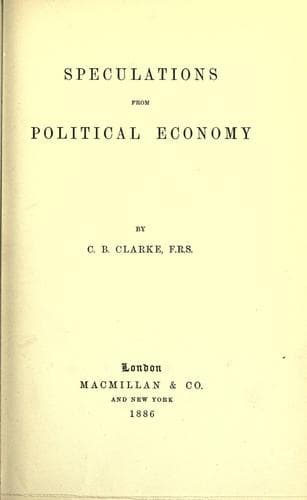
Speculations from Political EconomyClarke, Charles Baron
General
Speculations from Political Economy
Clarke, Charles Baron
Economics
Naturally there have been numerous schemes for a second railway from
London to Brighton in the course of the last twenty-five years. The
present railway company has (they are not to blame for it) opposed each
scheme tooth and nail. They have shown that they themselves satisfy the
requirements of the public, and at the same time do not make a very high
dividend. If a new grocer required an Act of Parliament to set up as
a tea-retailer in Canterbury, could not all the existing tea-retailers
there prove most triumphantly that an additional grocer was not wanted,
and that their own profits were reasonable? It is not too much to
say that the greater part of the evidence admitted by Parliamentary
Committees against proposed new railways is foolery: without wasting
time on it, the Parliamentary Committee might assume as proved that no
monopolist trader wants a competitor. But the only safety for the public
is in competition. In railway competition the public always profit: if
the two companies agree to run at the same fares, the public gain
in number and speed of trains, better carriages, and attentive
consideration of their comfort. Moreover, in the case of two railways
between London and Exeter, or between London and Brighton, the two
lines only meet (not then quite) at the two termini; and the public is
accommodated at all the new intermediate stations where there was no
station at all before.
The North-Western Railway was many years ago opposing a directly
competing scheme. They brought before the Parliamentary Committee the
late Mr. Horne, whom they justly credited with ability enough to throw
dust in the eyes of almost any Parliamentary five. Mr Home's evidence
was: "I understand railway traffic as well as anybody; the public are
deluded in thinking they would gain by competition: the two companies
might fight for a week or two, then they would more wisely agree, and
put up their fares above the present North-Western fares, till they had
recouped themselves out of the public all they had lost by their fight."
This did very well for the Parliamentary Committee; but it is a fallacy.
At present the North-Western Railway, though empowered by law to
charge three-pence a mile first-class, charge twopence a mile only:
why?--because twopence a mile they find to be on the whole the most
paying rate. Ergo, after the fight with their directly competing brother
was over, they would settle down to twopence a mile again. The public
could not lose by the competition; they might gain. All experience shows
that they invariably do gain.
Public-domain text, read in full here on John Shaqi.
Reviews
Reviews
No reviews yet
Be the first to share your thoughts on this work.
Join the Discussion
Join the discussion
Sign in to leave a comment or review.
Sign InorCreate an account