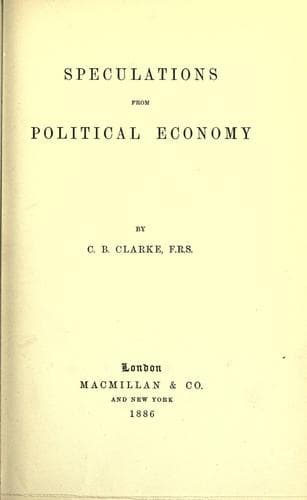
Speculations from Political EconomyClarke, Charles Baron
General
Speculations from Political Economy
Clarke, Charles Baron
Economics
The case of tea is a very specious one. By Government taking to itself
each branch of business in succession till all was in Government hands
we should arrive at Communism. For each successive interference of
Government a reason from economy can generally be found: as in the case
of telegraphs, so in the case of tea. The real objection to Government
monopolising the retail of tea is, that so long as we live under a
system of competition we had better stick to that plan altogether. At
every turn of our present struggling system there is waste; but the
ultimate effect of competition is to reduce the waste to a minimum. In
the extreme case of tea it is pretty clear that the system of stores
will, when fully developed, give the public all or nearly all they might
hope to get from Government retailing, and at the same time will reduce
the loss by competition among tea-retailers.
But there is one industry, one branch of the public service, which
should be the very last to be monopolised or restricted by Government,
viz., the carrying of passengers and goods from one place to another,
especially carrying by railway; and yet this particular industry is
hampered by law and restricted by monopolies above all others--as I
suppose, most unnecessarily; but I will take a few cases in detail
before arguing from the general principle of Free Trade.
There is one railway from London to Brighton: there are two railways
from London to Exeter. There are fewer quick trains daily from London to
Brighton than from London to Exeter. There are third-class carriages
at a penny a mile on all the quick trains from Waterloo to Exeter: from
London to Brighton the only penny a mile train starts at an inconvenient
hour and travels exceedingly slow. The Brighton charge express fares on
every convenient quick train they run; the South-Western have no express
fares at all. The South-Western third-class carriages are padded, and as
comfortable as the first; the Brighton third-class carriages are bare,
very long, and run so badly that the shaking, the rattling of glass, and
the draughts, keep everybody (who can possibly afford it) out of them.
Public-domain text, read in full here on John Shaqi.
Reviews
Reviews
No reviews yet
Be the first to share your thoughts on this work.
Join the Discussion
Join the discussion
Sign in to leave a comment or review.
Sign InorCreate an account