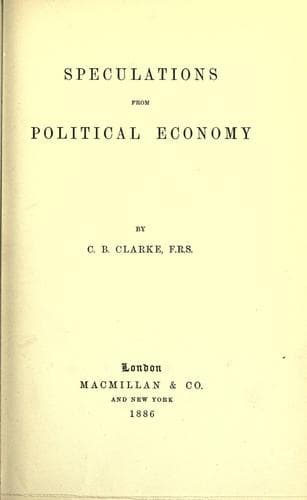
Speculations from Political EconomyClarke, Charles Baron
General
Speculations from Political Economy
Clarke, Charles Baron
Economics
As regards the interest of the public, the rate of dividend paid by a
great railway company is of very small importance. For many years the
South-Western Company paid double the dividend the Great Western did.
How did this affect the work each did for the public--the conveyance of
passengers and goods? Many common highways have been made by parishes
and landowners combined for the public convenience; the capital so laid
out paid no direct interest (the road was a highway, not a turnpike):
how does this case differ from a railway that pays no dividend on the
original stock? If the railway carried me from Exeter to London in five
hours for thirteen shillings, what does it matter to me whether
the company pays 2-1/2 per cent or 6-1/2 per cent to its original
shareholders? In a very few small and special cases we have seen a
railway line not pay for the working, and be closed. In a few other
cases, where the dividend paid is less than 4-1/2 per cent, it is
possible that the utility of the line to the public is less than the
loss of the shareholders in a non-paying investment. I say this is a
possible and conceivable case--in some very short lines or in some very
thinly inhabited districts. Such cases I believe rare. Not rarely the
initial cost of the line has been seriously increased by promotion,
legal and parliamentary expenses, enormous sums extorted for land,
severance, etc.; if these expenses can be done away with, these cases of
railways constructed at a loss _on the whole_ to the nation may be made
fewer still.
Public-domain text, read in full here on John Shaqi.
Reviews
Reviews
No reviews yet
Be the first to share your thoughts on this work.
Join the Discussion
Join the discussion
Sign in to leave a comment or review.
Sign InorCreate an account