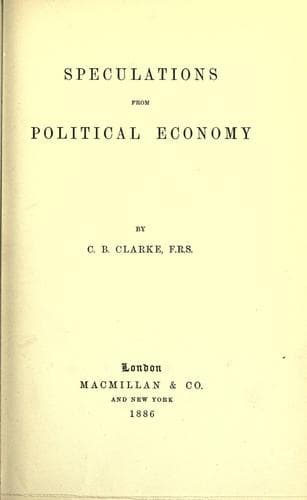
Speculations from Political EconomyClarke, Charles Baron
General
Speculations from Political Economy
Clarke, Charles Baron
Economics
The way in which the railway monopoly, the monopoly of the great
companies, has grown up is noteworthy. To enable a company to take
the land of a private man compulsorily a private Act of Parliament was
necessary. The Parliamentary Committees then said, We will not enable
you to dispossess forcibly private owners of their land for "a public
purpose" unless you further shew that this includes a public advantage.
Private owners were of course let in to show cause against a new
railway; they always talked like Naboth (the Parliamentary Committees
must have been wearied by the continual references to Naboth), but the
genuine private owners sold themselves at the last minute; after they
had pushed the company up to the highest bid, they well knew that this
was above what they could get in the after arbitration, and "closed,"
withdrawing their opposition the last day in the Committee room. The
opposition company, besides the grounds of insufficient need for a new
line, etc., always supports and comforts the opposing landowners: but
the great resource of the opposing company is to hire a landowner to
oppose, especially a local attorney or agent who owns land proposed to
be taken by the new line. Such an attorney, employed professionally by
the opposing company, cannot be bought off at any price; he is a real
Naboth, and in his character of a dispossessed landowner he will
fight for the company every point that they cannot decently fight for
themselves.
Opposing a railway bill in Parliament has thus become an art; so much
so, that no independent small line can be made unless they can get the
support of one (at least) of the great companies that are supposed
to occupy the area. The lines made (economically often) by the great
companies themselves are not primarily designed for the accommodation of
the public, but for the private purposes of the great company; sometimes
they are made merely to diddle another great company.
It is well to compare the law regarding making a new railway with that
for making a new main-drain in the fens. In the latter case the new
drain company receives extraordinary powers and may put a rate on the
land benefited. In the case of a railway passing through a farm, the
common estimate is that it adds a shilling an acre value to the rent of
the farm; if there is a station on the farm it often adds much more
to the agricultural value. Landlords are up to this: a landlord
triumphantly told me, "I got £7000 from that company for cutting me up;
but I would have given them £14,000 to cut me up more." (In this case,
however, building value came in.) But the disgraceful squabbling of
companies, who "sell" any owner without scruple when they come to terms
among themselves, has disgusted landlords from actively supporting
railway schemes.
Public-domain text, read in full here on John Shaqi.
Reviews
Reviews
No reviews yet
Be the first to share your thoughts on this work.
Join the Discussion
Join the discussion
Sign in to leave a comment or review.
Sign InorCreate an account