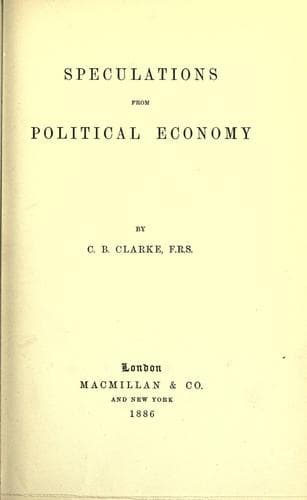
Speculations from Political EconomyClarke, Charles Baron
General
Speculations from Political Economy
Clarke, Charles Baron
Economics
A less but important branch of this reform is the narrowing of
Government interference under pretence of protecting the public. Great
expenses are thus thrown on railway companies. The companies cannot,
therefore, charge increased fares, but such expenses diminish the number
of new railway schemes brought forward. Nor do Government rules protect
the public so well as the old plan (abolished by Chief-Justice Cockburn)
of making the railway company pay for killing or injuring people. Now,
after a great railway smash, the company comes forward and shows that
there was no negligence on their part; that in the signals, breaks,
etc., they had satisfied all the Board of Trade regulations, and
the injured passengers can get nothing. The real way to protect the
passengers is to allow the company to make their own arrangements, and
to compel them to pay heavily for killing and maiming passengers. This
is quite defensible in theory, as in the case of manslaughter by an
individual we give him some punishment out of our civilised respect
for human life, though he may have been little to blame. Great cost is
thrown on railway companies (i.e. much injury is done the public) by
standing orders (cast-iron orders) about gradients, etc. The company's
solicitors order the company's engineer to comply with standing orders
at all costs rather than introduce any special clause. The consequence
is that we see much money spent and a most inconvenient level-crossing
placed at the entrance to some large town, where a steep gradient for
two hundred yards on a straight piece of road (to which there is no
objection) would have avoided all difficulty. The responsibility in all
such cases should be thrown on the company, and Government interference
abolished.
7. REFORM IN LAND LAW.
The transfer of stock in the name of two trustees in the funds is
done in a few minutes at small expense. The transfer of land in South
Australia is done in a few minutes at small expense at the Government
registry. The transfer of land in England requires an uncertain time
and cost--usually some weeks, and 5 per cent on the purchase money;
sometimes months, and 10 to 25 per cent on the purchase money. It
is equally expensive and slow in the register counties of York and
Middlesex. The Acts of Brougham, Bethell, Cairns, to facilitate transfer
have not materially reduced the evil. In many cases, however much the
land may be wanted for public or other purposes, the lawyers tell
you that no title can be made without a private Act of Parliament--so
effectually has the land been tied up.
The common idea is that this peculiar difficulty, delay, and cost in
the transfer of land arise from the law of inheritance and the legal
machinery of entail; but stock in the funds can be virtually entailed
and made to "follow the estate," and yet this stock can be transferred
just as readily as any other stock.
Public-domain text, read in full here on John Shaqi.
Reviews
Reviews
No reviews yet
Be the first to share your thoughts on this work.
Join the Discussion
Join the discussion
Sign in to leave a comment or review.
Sign InorCreate an account