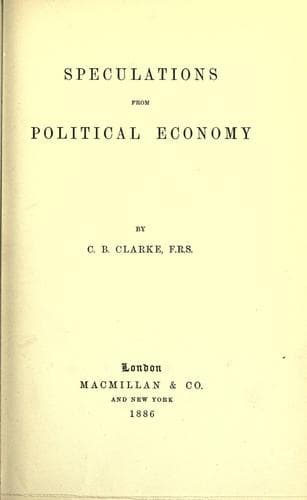
Speculations from Political EconomyClarke, Charles Baron
General
Speculations from Political Economy
Clarke, Charles Baron
Economics
For, first, few new railways would be in direct competition with the
old. The old lines have level roads; they can run quicker and with less
wear and tear than the new ones, which would generally have steeper
gradients. The new Free Trade lines would be in the main a network in
the interstices of the present lines. By this the existing companies
would gain enormously; they would be the trunk lines which the network
would feed. It is true that there would soon be a second line to
Brighton; the present Brighton Company would possibly pay as good a
dividend then as they do now. But if they did not, it would only show
how they tax the public now as well as hinder trade. I am not bound to
show that the monopolists would profit by Free Trade; I deny that
the monopolists have any vested interest in their monopoly, or that
Parliament, i.e. the nation, has made any covenant with them that their
monopoly shall never be invaded.
I have suggested three great changes: (1) Perfect Free Trade at all our
ports; (2) The exploitation of the land through the National Rate Book
machinery; (3) Free Trade in Railways. Of these the last is clearly
advisable, nor is there anything (in my opinion) to be urged on the
other side. At the same time it is not less important than either of
the two other suggestions. But the three would work best together--each
aiding and reacting on the other; they would thus provide "progress"
(which means comfort to all classes) in England for at least two
generations of men. If there was no National Rate Book, the new railways
would have to pay exorbitantly for the land they took up under the
existing arbitration system; they would be relieved merely from the
parliamentary opposition of other companies and of private individuals.
The private owner must be deprived of his present privilege of
parliamentary opposition, which gives him the power to extort an
exorbitant price for his land--because a company can always oppose in
the garb of some private owner whom they have hired.
Public-domain text, read in full here on John Shaqi.
Reviews
Reviews
No reviews yet
Be the first to share your thoughts on this work.
Join the Discussion
Join the discussion
Sign in to leave a comment or review.
Sign InorCreate an account