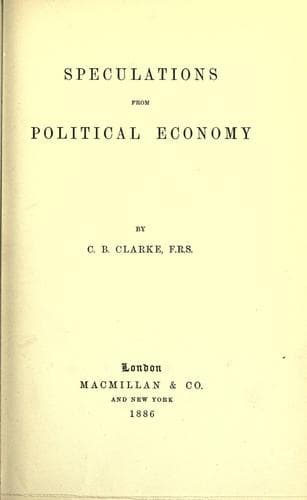
Speculations from Political EconomyClarke, Charles Baron
General
Speculations from Political Economy
Clarke, Charles Baron
Economics
The law of entail in England (so called) is not what the popular orators
suppose. The eldest son inherits really; that is, if there be no will,
no settlement, or other disposition of the property. But there nearly
always is. It is a very rare thing for the heir-at-law to take land
(except some very small pieces) by the law of inheritance. As to entail,
it is practically carried out by a continued system of surrender
and re-settlement--a device of lawyers which is, in its historical
development, an evasion (rather than a part) of the law. Nevertheless,
I think it is a matter of importance that the shackles which fetter land
should be loosened, and that the present powers of owners to tie up
land legally should be very much curtailed. It is a sad proof of the
way riches cling to the heart of man even when he is leaving this world,
that, whatever powers of tying up land are sanctioned, an owner will
usually exert them to the uttermost. He is leaving his property, but he
will keep a hold on it fifty years after he is dead if he can. He will,
after exhausting his powers in life interests, leave the residuum to
an unborn child "in strict tail-male so far as the rules of law will
permit;" and he will stick in a springing use to effect that, if his
greatnephew, the Rev. George, should ever from an Anglican become a
pervert to Roman Catholicism, he shall take no benefit under the will.
Now the fact is that all tying up is to the detriment of the public. No
man can provide for all contingencies. Indeed he can see so little a
way ahead that in a few years it frequently happens that all the careful
provisions of the will are working exactly as the testator would have
desired them not to work. Land tied up is always worth less to the
owner because it is tied up; and we have seen that the interest of the
commonwealth is the sum of the interests of all its component members.
When you tell me that an estate is now of small value to its life-owner
and unget-at-able for any public purposes, in consequence of a will made
by a man who died twenty years ago, it appears to me that you shew me
convincingly that we have not Free Trade in land.
I would propose that, either by will, settlement, or other instrument,
an owner should be able to give any number of life interests, and
nothing more; all trusts being placed outside the law. The first
objection will be that if the powers of owners are so restricted, the
desire for the ownership of land will be lessened: the value of all the
land in England will fall. This might be so, I admit, to some extent;
and it would favour the employ of the land for agricultural profit.
Public-domain text, read in full here on John Shaqi.
Reviews
Reviews
No reviews yet
Be the first to share your thoughts on this work.
Join the Discussion
Join the discussion
Sign in to leave a comment or review.
Sign InorCreate an account