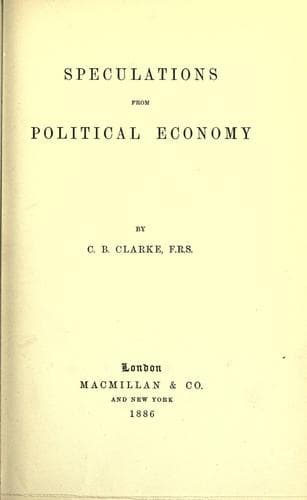
Speculations from Political EconomyClarke, Charles Baron
General
Speculations from Political Economy
Clarke, Charles Baron
Economics
The next objection is that it would become necessary to give land (and
money) directly to women without the intervention of trustees: that
women do not understand business and require to be taken care of. My
reply is that they always will require to be taken care of unless they
are entrusted with the management of their own affairs. The loss to the
nation, the expenses, the sacrifice of time and labour in trusteeships,
have now assumed gigantic proportions. If women were given their own
property to manage, some would (at first) fool it away: we know what
high interest, adventurers, unprincipled persons, etc., can effect. But
each woman defrauded or stripped of her property to starve would be
a warning to all the rest: in a few years women would manage their
property just as well as men. I believe they would manage it better.
A smaller percentage of women would gamble on the Stock Exchange, the
Mining Exchange, Austrian and Spanish lotteries, and horse-races; and
a much smaller percentage of women would embark in desperate "business"
speculations, heavy purchases of foreign produce, etc.
It should be noted that in cutting down the powers of owners to legally
tie up, I do not interfere with honourable trusteeships of any kind not
enforceable by law or in equity. Such exist now, and more largely than
is generally supposed. The absolute devises and bequests to friends (not
relatives) are often on private (not expressed) trust to provide for
illegitimate children or numerous other purposes which a man may not
wish to parade to his family.
8. EQUALISING OF TAXATION.
There has been no readjustment of the land tax for very many years. It
is a property rate, and originally was rateably levied at four shillings
in the pound. By the small increase in value of some land, the large
increase in value of other land, since the days of Queen Anne, it has
now become unequal in the highest degree. The farm A, gross rental £100
a year, has a land tax of £5 a year; the suburban estate B, gross rental
£1000 a year, has a land tax of £2:l0s. a year. The land tax assessors
were sworn in annually (twenty years ago, and may be still) to assess
the tax equally, but it was perfectly understood that the tax was to be
collected every year on the old long-standing assessment.
Suppose that the estates A and B above were reassessed, and that the
land tax on A was put 15s. per annum, that on B £6:15s. a year. Land
tax can be redeemed at about thirty years' purchase. The effect of the
readjustment would have been to take about £120 from the owner of B and
give it in a lump sum to the owner of A. It is probable that the present
owners of both A and B (or predecessors under whom they claim) had
purchased the estates A and B after the land tax had become fixed on
them, and the amount of land tax would then have been fully considered
in the price paid.
Public-domain text, read in full here on John Shaqi.
Reviews
Reviews
No reviews yet
Be the first to share your thoughts on this work.
Join the Discussion
Join the discussion
Sign in to leave a comment or review.
Sign InorCreate an account