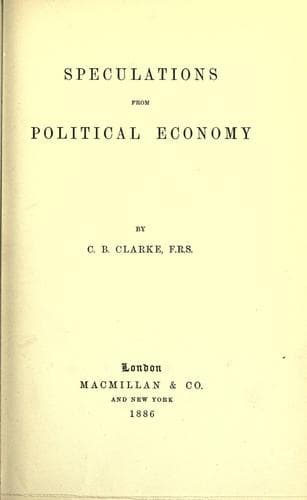
Speculations from Political EconomyClarke, Charles Baron
General
Speculations from Political Economy
Clarke, Charles Baron
Economics
One illustration more. Thirty years ago there were few more wretched
trades than the shoemakers of Northampton. Wages were low, the labour
was severe, the social condition of the workmen was necessarily low
also. The sewing-machine, with some special adaptations to make it sew
leather, increased about sixfold the bootmaking power of a workman. It
is needless to say that the Northampton shoemakers met the introduction
of this machine with the fiercest opposition: they said five-sixths of
their number must be thrown out of employment. The struggle was won by
the machine (as in other cases); shoemakers' wages have ruled 50 to
100 per cent higher ever since, at the same time that the shoemaking
population has largely increased; and the social comforts and character
of the workpeople have improved vastly too. This is an example that has
always puzzled the workmen themselves; but it requires no explanation
after what has been said about the efficiency of labour. The puzzle to
the shoemakers is what becomes of the additional boots and shoes made.
They do not reflect that, even of a necessary of life, only a certain
quantity is used at a certain price. Nothing is more necessary in
London, especially in winter, than coal; but, when coal some years ago
went up to 40s. a ton in London, it was marvellous how people in all
ranks managed to reduce their consumption of coal. Much more in the case
of boots, which will bear the cost of export to remote countries, did
the demand increase as the price fell. A fall of 10 per cent only in the
price of boots would cause every wholesale boot exporter to export on
the largest scale. No doubt the invention of a self-acting machine
which should turn out 1000 pairs of boots an hour at a nominal cost
of workmanship per pair would reduce the shoemakers of Northampton to
idleness and starvation. But in practice it has rarely happened that any
machine has been introduced in any trade that has thus completely choked
the increased demand. It has happened often that the workmen who could
only work the old way, and were not able to take up the new machine,
have been reduced to starvation. Even then, after this generation has
passed away, the new machine-workers have been better off than their
predecessors.
Employers of labour cannot pay as wages more than the labour is worth:
no organisation or rules will make them. But employers may pay a good
deal less than the labour is worth, and often have done so. However
great their profits, there is, according to J. S. Mill, always a tacit
understanding among all employers of labour to pay the minimum the
labourers can be induced to accept. It is only by combination that the
labourers can get the full value of their efficiency. Here Mr. Arch
comes in: I have little doubt that the flail-threshers might, under a
well-managed large trade combination, have got nine shillings a week
instead of eight shillings forty years ago.
Public-domain text, read in full here on John Shaqi.
Reviews
Reviews
No reviews yet
Be the first to share your thoughts on this work.
Join the Discussion
Join the discussion
Sign in to leave a comment or review.
Sign InorCreate an account