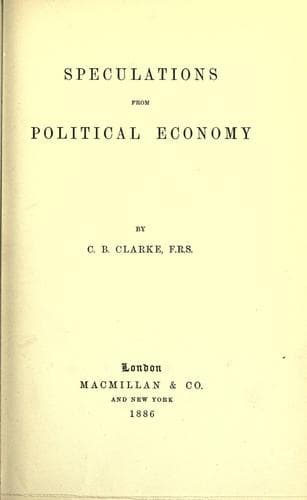
Speculations from Political EconomyClarke, Charles Baron
General
Speculations from Political Economy
Clarke, Charles Baron
Economics
But every rise in wages gained by the workmen, unless springing from
or in conjunction with an increase in efficiency, will tell against
themselves; it must increase the price of the article, whether houses,
wheat, or boots; this must diminish the demand for the article, and this
must throw some of the workmen out of employ.
It is difficult to find an example of price of wages which presents
any difficulty of explanation when we apply to it the consideration
of efficiency. If bricklayers were to offer to exert themselves to the
utmost, and do in eight hours the same amount and quality of work they
now do in nine, the speculative builders would doubtless be willing to
give the same wages for eight hours' work that they now give for nine.
In case the labourers by increase in their efficiency are able to get
higher wages, the choice will (in general) lie with them how much of
the increase they take in increased money wages, how much they take in
shortened hours of labour. We thus see how, in an uncivilised community,
owing to the inefficiency of their labour, their whole time and energies
are expended on their hunting, or otherwise providing bare subsistence.
The greater skill of our civilised labourers, working with machines
provided by our science, and profiting by our fixed capital (as our
railway tunnels and embankments), is vastly more efficient: it ensures
the labourers a certainty and regularity of food which the savage does
not enjoy, and provides him a certain margin of leisure beyond what the
inefficient savage labourer can count upon; it also provides the whole
surplus production out of which the intellectual and leisure classes are
supported.
It is to be noted that an increase of efficiency in any industry (and
very largely in the case of industries producing generally essential
utilities) raises real wages in all other industries, and this, whether
the particular trade gains (as we have seen it nearly always do)
or loses, as is conceivable, though rarely occurring. Thus, if the
introduction of a boot-sewing machine lowers the price of boots 50
per cent, this can have no effect in lowering the money wages of farm
labourers; and, as a matter of fact, the fall in cost of boots has
sensibly improved the position of farm labourers. In the same way the
superior efficiency of carriers by railway over the old road carriers
has diminished the cost of coal and all articles (the bulky ones most
sensibly) in all parts of England. There thus arises the instructive
result that handicrafts in which there has been no improvement in the
last forty years have obtained a rise of real wages (amounting in some
cases to 50 per cent) by the improvements in efficiency in all the
trades around them.
Public-domain text, read in full here on John Shaqi.
Reviews
Reviews
No reviews yet
Be the first to share your thoughts on this work.
Join the Discussion
Join the discussion
Sign in to leave a comment or review.
Sign InorCreate an account