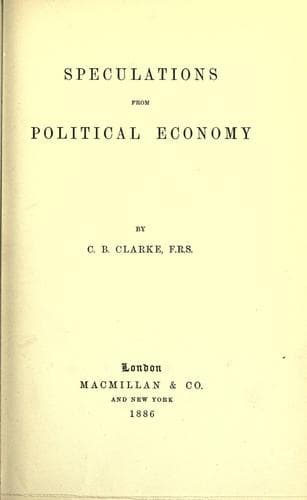
Speculations from Political EconomyClarke, Charles Baron
General
Speculations from Political Economy
Clarke, Charles Baron
Economics
Of this £150,000,000 that is now annually remitted to England, not
in the way of exchange, some small portion is transferred by wealthy
Australians returning to settle in England for purchase of houses, etc.,
in England; but by far the greater portion is the interest of capital
owned by men resident in England, but invested abroad: it may be shortly
termed tribute. This is mainly invested in the Colonies and India; New
Zealand and Australia taking large shares. There is also much English
capital invested in Continental railways, etc.; but it is noteworthy
how capital (as well as commerce) follows the flag. The English capital
invested in the United States is absolutely large, but relatively (to
that invested in Canada, etc.) very small. It is certain that if the
United States were under Queen Victoria the amount of English capital
invested there would be far greater than at present.
As far as England is concerned this £150,000,000 a year is a tribute
paid her by the rest of the world. New Zealand or South Australia may
take up a million sterling in London (because they get the loan placed
there at 5 or 6 per cent, while the local rate of interest in Australia
is far higher) in order to make a railway which perhaps pays the local
Government as much as the interest of the money they give to England.
Still, the capital being once fixed in Australia while (by hypothesis)
the stock is held in England, the result is equivalent to a tribute.
All Liberal stump-orators now agree in telling the agricultural
population that their improved position is due to Free Trade (in wheat),
and that therefore they should vote for the Liberals. Nothing is done
more confidently in politics and history than the settling the causes of
events, or predicting what would have been the course of events had
some result been different, as, for instance, had the separation of the
United States from England not occurred. The truth is that in politics
causes are many; they act and react on each other in their operations;
and to say exactly how much is due to one cause, or how much that cause
acting alone would have effected, is impossible. To get some judgment
how much of the present prosperity of the agricultural labourers
(admitted on all sides as compared with their position in 1846) is
due to free importation of wheat alone, let us (merely as a scientific
artifice) imagine that a regular sliding-scale duty on wheat were put
on now, bringing wheat to 48s. a quarter permanently. What would be the
effect on the agricultural population? We may suppose that the produce
of the duty, were it five or eight millions, or any other sum, was
employed in remitting the duties on tea or other productions generally
consumed by agricultural labourers. The placing of wheat at 48s. a
quarter permanently would at once recall a good deal of capital to the
land, it would carry out further the margin of cultivation, and at the
Public-domain text, read in full here on John Shaqi.
Reviews
Reviews
No reviews yet
Be the first to share your thoughts on this work.
Join the Discussion
Join the discussion
Sign in to leave a comment or review.
Sign InorCreate an account