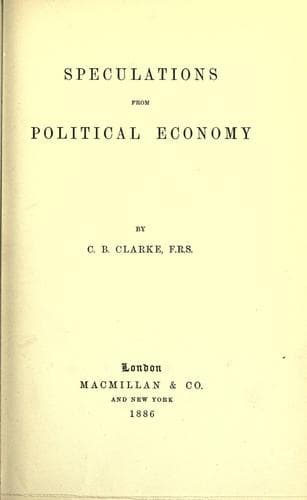
Speculations from Political EconomyClarke, Charles Baron
General
Speculations from Political Economy
Clarke, Charles Baron
Economics
Adam Smith and his followers, and still more closely Ricardo, divided
their Political Economy into two parts: in the first they consider the
wealth of the nation without the "complication" of foreign trade, _i.e._
they, in fact, contemplate no money or goods as going out or coming
in whatever. They then in separate chapters, forming a big appendix,
consider the effects of Foreign Trade as a series of exchanges. They
do not discuss even the payment of a lump sum of gold to a victorious
nation. Senior, in his _Handbook of Political Economy_, has considered,
first, the economy of the world conceived as a solitary, island of
small size in a world-covered sea; secondly, he treats foreign trade
by conceiving two such islands. There is no better way of treating
Political Economy than this; and it is well for the beginner to conceive
the solitary island with fifty (or a limited number of) families only
on it, and work through the ordinary theorems (with figures) in this
restricted case. Whatever is true of the fifty families in a small
island must be true for 5,000,000 families in a big island.
The facilities of modern communications have caused most countries to
differ in their circumstances materially from the conditions assumed by
Adam Smith and his successors as axioms. In the case of England,
owing to its numerous wealthy colonies, gigantic foreign trade, and
consequently world-over-spread capital, the circumstances are so
completely altered that many results of the grammar of Political Economy
no longer apply even in the rough to England. If Adam Smith had been
asked what would happen to England if the imports for one year exceeded
the exports by £150,000,000 sterling, he would have given the same
answer as his predecessors, who reckoned wealth in gold and silver, or
more probably he would have declined answer, pronouncing such a state
of things an impossible conception. It is now as difficult to treat
politico-economically the wealth of the nation as the wealth of
Warwickshire--a difficulty that Adam Smith would have shrunk from.
It is true that every abstract proposition concerning rent, capital,
and wages now (and always) holds true for the whole world; but, so
conceived, the propositions give no practical result. These things do
not lesson the value of the science of Political Economy, Mr. Ranken
or Dr. Pole would estimate very highly the value of a knowledge of
elementary mechanics to the humblest engineer, though such elementary
mechanics might not extend to the consideration of friction, etc., and
might not be applicable to any bridge or steam-engine.
Public-domain text, read in full here on John Shaqi.
Reviews
Reviews
No reviews yet
Be the first to share your thoughts on this work.
Join the Discussion
Join the discussion
Sign in to leave a comment or review.
Sign InorCreate an account