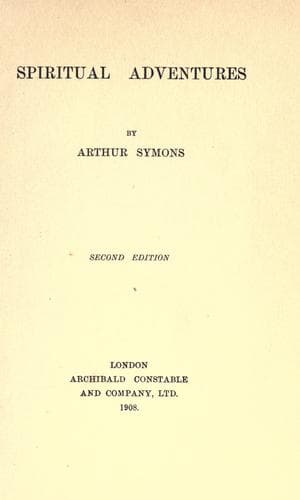
Great Britain -- Social life and customs -- 19th century -- Fiction; Short stories
When he came back to play again, he looked nervously at the top of the
piano, but there was nothing to be seen. He sat down, and bent over the
keyboard, and his hands began to run to and fro softly. When he looked
up he saw what he was playing as clearly as he could have seen the notes
if they had been there: but the wavy line was upright now, and drifted
upwards swiftly, vanishing at a certain point; it swayed to and fro like
a snake beating time to the music of the snake-charmer; and he looked at
it as if it understood him, and nodded his head to it, to show that he
understood. By this time it seemed to him quite natural, and he forgot
that there had ever been a time when he had not seen the music like
that.
On his way home after the concert, it occurred to him that something
unusual had happened, but he could not remember what it was. He dined by
himself, and after dinner went out into the streets, and walked in the
midst of people, as he liked to do, that he might take hold of something
real. But he could not concentrate his mind, he seemed somehow to be
slipping away from himself, dissolving into an uneasy vacancy. The
people did not seem, very real that night: he stopped for a long time at
the corner of the pavement, near Piccadilly Circus, and tried to see
what was going on around him. It was quite useless. The confusing
lights, the crush and hurry of figures wrapped in dark clothes, the
noise of the horses' hoofs striking the stones, the shouts of
omnibus-conductors and newsboys, all the surge and struggle of horrible
exterior forces, seeming to be tightened up into an inextricable
disorder, but pushing out with a hundred arms this way and that, making
some sort of headway against the opposition of things, brought over him
a complete bewilderment. 'I can see no reason,' he said to himself, 'why
I am here rather than there, why these atoms which know one another so
little, or have lost some recognition of themselves, should coalesce in
this particular body, standing still where all is in movement.' He
looked at the horses pulled back roughly at a cross-current, and tossing
back their heads as the hind-legs grew convulsively rigid, and he felt
sorry for them, and wondered why the driver was driving them and why
they were not driving the driver. Some one ran violently against him,
and apologised. The shock did nothing to wake him up; he noticed it,
waited for the effect, and was surprised that no effect came.
'Decidedly,' he said to himself, 'I am losing my sense of material
things, for, slight as it always has been, I have always resented being
pushed into the mud.'
Public-domain text, read in full here on John Shaqi.
Reviews
Reviews
No reviews yet
Be the first to share your thoughts on this work.
Join the Discussion
Join the discussion
Sign in to leave a comment or review.
Sign InorCreate an account