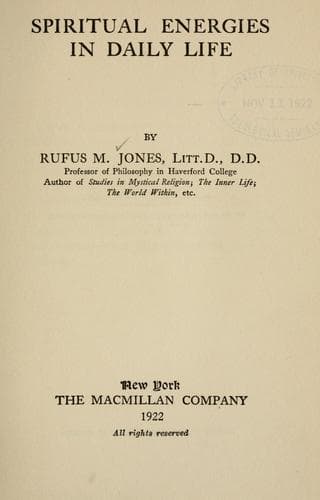
Spiritual Energies in Daily LifeJones, Rufus M. (Rufus Matthew)
Religion
Spiritual Energies in Daily Life
Jones, Rufus M. (Rufus Matthew)
Spiritual life
SOME NEW REASONS FOR “LOVING ENEMIES”
Nobody ever amounts to anything who lives without conflict with
obstacles. It seems to be a law of the universe that nothing really good
can be got or held by soft, easy means.
The Persians were so impressed with this stern condition of life that
they interpreted the universe as the scene of endless warfare between
hostile powers of the invisible world. Ormuzd, the god of light, and
Ahriman, the god of darkness, were believed to be engaged in a continual
Armageddon. There could be no truce in the strife until one or the other
should win the victory by the annihilation of his opponent. This Persian
dualism has touched all systems of thought and has left its influence
upon all the religions of the world. The reasons why it has appealed so
powerfully to men of all generations are, of course, that there is so
much conflict involved in life and that no achievement of goodness is
ever made without a hard battle for it against opposing forces. But if
all this opposition and struggle is due to an “enemy,” we certainly ought
to love this “enemy,” because it turns out to be the greatest possible
blessing to us that we are forced to struggle with difficulties and to
wrestle for what we get.
“Count it all joy,” said the Apostle James in substance, writing to his
friends of the Dispersion, “when you fall into manifold testings, or
trials, knowing that the proving of your faith worketh steadfastness,
and let steadfastness have its perfect work, that ye may be perfect and
entire, lacking in nothing.” St. Paul thought once that his “thorn in the
flesh” was conferred upon him by Satan and was the malicious messenger
of an enemy; but in the slow process of experience he came to see that
the painful “thorn” exercised a real ministry in his life, that through
his suffering and hardship he got a higher meaning of God’s grace; and he
discovered that divine power was thus made perfect through his weakness,
so that he learned to love the “enemy” that buffeted him.
The Psalmist who wrote our best loved psalm, the twenty-third, thought at
first that God was his Shepherd because he led him in green pastures and
beside still waters where there was no struggle and no enemy to fear. But
he learned at length that in the dark valleys of the shadow and on the
rough jagged hillsides God was no less a good Shepherd than on the level
plains and in the lush grass; and he found at last that even “in the
presence of enemies” he could be fed with good things and have his table
spread. The overflowing cup and the anointed head were not discovered
on the lower levels of ease and comfort; they came out of the harder
experiences when “enemies” of his peace were busy supplying obstacles
and perplexities for him to overcome.
Public-domain text, read in full here on John Shaqi.
Reviews
Reviews
No reviews yet
Be the first to share your thoughts on this work.
Join the Discussion
Join the discussion
Sign in to leave a comment or review.
Sign InorCreate an account