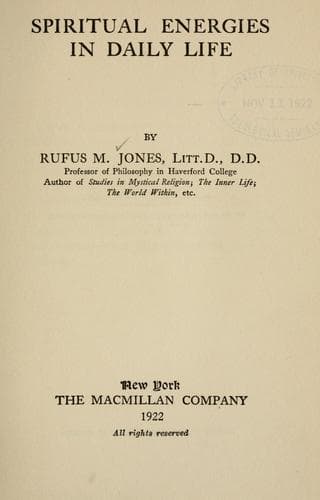
Spiritual Energies in Daily LifeJones, Rufus M. (Rufus Matthew)
Religion
Spiritual Energies in Daily Life
Jones, Rufus M. (Rufus Matthew)
Spiritual life
But when we turn from ships and airplanes to the provisions for training
young persons we are in a different world. The element of chance now
bulks very large. We let the youth have pretty free opportunity to begin
his malformation before we begin seriously to construct him on right
lines. We fail to note what an enormous fact “disposition” is, and we
take little pains to form it early and to form it in the best way. We
are far too apt to assume that all the fundamentals come by the road
of heredity. We overwork this theory as much as earlier theologians
overworked their dogma of original sin from poor old Adam.
The fact is that temperament and disposition and the traits of character
which most definitely settle destiny are at least as much formed in those
early critical years of infancy as they are acquired by the strains of
heredity. Education, which is more essential to the greatness of any
country than even its manufactures, is one of the most neglected branches
of life. We take it as we find it—and lay its failures to Providence
as we do deaths from typhoid. It must not always be so. We must be as
greatly concerned to form virile character in our boys and girls and
to develop in them the capacity for moral and spiritual leadership in
this crisis as we are concerned over our coal supply or our industries.
There are ways of assisting the higher self to control and dominate the
life, ways by which the ideal person can become the real person. Why not
consider seriously how to do that?
He that overcomes, the prophet of Patmos says, receives a white stone
with a new name written on it, which no man knoweth save he that hath
it. It is a symbolism which may mean many things. It seems at least to
mean that he who subdues his lower self, holds out in the strain of life,
and lives by the highest that he knows, will as a consequence receive a
distinct individuality, a clearly defined self, instead of being blurred
in with the great level mass—a self with a name of its own. And that self
will not be the old familiar self that everybody knows by traits of past
achievement and by the old tendencies of habit. It will be the self
which only God and the person himself in his deepest and most intimate
moments knew was possible—and here at last it is found to be the real
self. The man can say, “I am.” He has come to himself.
We ask, at the end, whether it may not be that the world will soon come
to itself and discover the way back to some of its missed ideals. Here on
a large scale we have the story of a desperate hunger, squandered wealth,
lost shoes, lost tunics, and even more precious things gone—a world that
has missed its way and is floundering about without sufficient vision
or adequate leadership. If it could only come to itself, discover what
its true mission is and where its real sources of power and its line of
progress lie, it would still find that God and man together can rebuild
what man by his blunders has destroyed.
III
Public-domain text, read in full here on John Shaqi.
Reviews
Reviews
No reviews yet
Be the first to share your thoughts on this work.
Join the Discussion
Join the discussion
Sign in to leave a comment or review.
Sign InorCreate an account