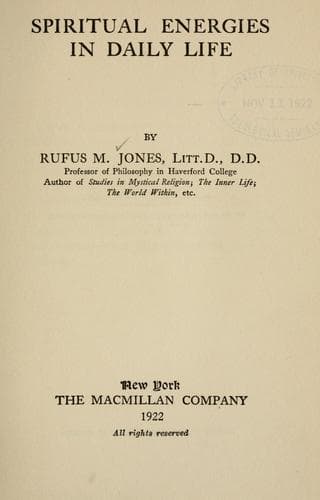
Spiritual Energies in Daily LifeJones, Rufus M. (Rufus Matthew)
Religion
Spiritual Energies in Daily Life
Jones, Rufus M. (Rufus Matthew)
Spiritual life
are, however, with a beyond within ourselves, the fact of mutability and
mortality has occasioned a transformation of our entire estimate of life
and has led us by the hand to a Pisgah view which we should never have
got if there had been no invasion of death into our world.
“It is a venerable commonplace,” as Professor Schiller of Oxford has
said, “that among the melancholy prerogatives which distinguish man
from the other animals and bestow a deeper significance on human life
is the fact that man alone is aware of the doom that terminates his
earthly existence, and on this account lives a more spiritual life, in
the ineffable consciousness of the ‘sword of Damocles’ which overshadows
him and weights his lightest action with gigantic import. Nay, more;
stimulated by the ineluctable necessity of facing death, and of living so
as to face it with fortitude, man has not abandoned himself to nerveless
inaction, to pusillanimous despair; he has conceived the thought, he
has cherished the hope, he has embraced the belief, of a life beyond
the grave, and opened his soul to the religions which baulk the king of
terrors of his victims and defraud him of his victory. Thus, the fear
of death has been redeemed, and ennobled by the consoling belief in
immortality, a belief from which none are base enough to withhold their
moral homage, even though the debility of mortal knowledge may debar a
few from a full acceptance of its promise.”[4]
The early animistic views of survival, which were the first forecasts of
a life beyond, were due not so much to the consciousness of the moral
grandeur of life as to _actual experiences_ which gave to primitive
man a confident assurance of some form of life after the death of the
body. Dreams had an important part in leading man to this naïve and yet
momentous discovery. In a world which had no established criterion of
“reality,” the experiences of vivid dreams were taken to be as real as
any other experiences, and in these dreams the dreamer often found his
dead ancestors and friends and tribesmen once more present with him,
active in the chase or the fight and as real as ever they were in life.
Trance, hallucination, telepathy, mediumship, possession, are not new
phenomena; they are very primitive and ancient. These things are as old
as smiling and weeping. These psychic experiences had their part to
play also in giving the early races their belief that the dead person
still existed though in an altered and attenuated form as an _animus_ or
“spirit” or “shade.” This empirical view of survival, built on actual
experiences, was more or less incapable of advance. No further knowledge
could be acquired and the constructions fashioned by imagination, in
reference to “the scenery and circumstance” of the departed soul, could
satisfy only an uncritical mind. These constructions were, too, often
crude and bizarre, and tended, in the hands of priests, to hamper man’s
moral development rather than to further it.
Public-domain text, read in full here on John Shaqi.
Reviews
Reviews
No reviews yet
Be the first to share your thoughts on this work.
Elsewhere in the archive
Join the Discussion
Join the discussion
Sign in to leave a comment or review.
Sign InorCreate an account