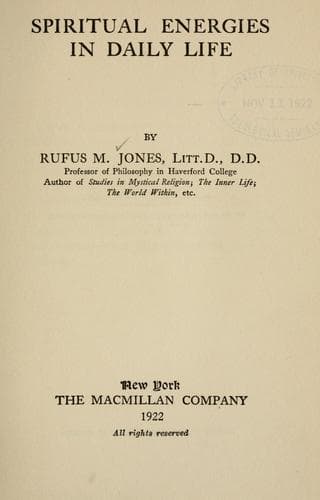
Spiritual Energies in Daily LifeJones, Rufus M. (Rufus Matthew)
Religion
Spiritual Energies in Daily Life
Jones, Rufus M. (Rufus Matthew)
Spiritual life
But in any case man had made
the momentous guess that death did not utterly end him or his career.
Poor and thin as this dimly conceived future world of primitive man’s
hope may have been, the psychological effect of the hope was by no means
negligible. Professor Shaler of Harvard was probably speaking truly when
he wrote:
“If we should seek some one mark, which in the intellectual advance from
the brutes to man, might denote the passage to the human side, we might
well find it in the moment when it dawned upon the nascent man that death
was a mystery which he had in his turn to meet. From the time when man
began to face death to the present stage of his development there has
been a continuous struggle between the motives of personal fear on the
one hand, and valor on the other. That of fear has been constantly aided
by the work of the imagination. For one fact of danger there have been
scores of fancied risks to come from the unseen world. Against this great
host of imaginary ills, which tended utterly to bear men down, they had
but one helper—their spirit of valiant self-sacrifice for the good of
their family, their clan, their state, their race, or, in the climax, for
the Infinite above.”[5]
It marked a still greater intellectual advance when primitive man came to
the immense conclusion not only that death was a mystery which he in turn
must meet, but that he was a being that would survive death.
It is, however, in another field that we must look for the most important
spiritual results from the contemplation of death, that is in what we
may call the field of spiritual values. I have already contended that
man’s greatest discovery was his discovery of the absolute value of moral
personality. Of course, it came fairly late in the development of the
race and by no means has everybody made it yet! But at any rate there
came a time somewhere in the process of history when man did discover a
beyond within himself, a greater inclusive self present within his own
fragmentary, finite spirit, revealed as a passion for perfection not yet
attained or experienced, a prophesying consciousness of eternity within
his often baffled and defeated temporal life. No one has expressed the
fact of this inner beyond within us better than old Sir Thomas Browne
did in the seventeenth century: “We are men and we know not how; there
is something in us that can be without us and will be after us, though
it is strange that it hath no history of what it was before us, nor can
tell how it entered in us.... There is surely a piece of Divinity in us,
something that was before the elements and owes not homage unto the Sun.”
Public-domain text, read in full here on John Shaqi.
Reviews
Reviews
No reviews yet
Be the first to share your thoughts on this work.
Elsewhere in the archive
Join the Discussion
Join the discussion
Sign in to leave a comment or review.
Sign InorCreate an account