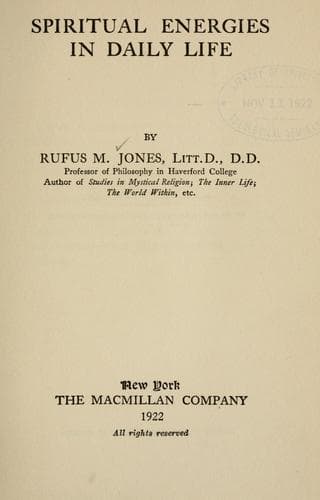
Spiritual Energies in Daily LifeJones, Rufus M. (Rufus Matthew)
Religion
Spiritual Energies in Daily Life
Jones, Rufus M. (Rufus Matthew)
Spiritual life
We are thus once more reduced to a condition of sheer naturalism. Our
stream of consciousness is only a rapid succession of passing states,
each “state” causally attached to a molecular process in the brain.
“Every _psychosis_ is the result of a _neurosis_.” There is no soul,
there is no creative spiritual pilot of the stream, there is no freedom,
there are no moral values, there is nothing but passing “cosmic weather,”
sometimes peeps of sunshine, sometimes moonshine, sometimes drizzle or
blizzard, and sometimes cyclone or waterspout! To meet the appalling
thinness of this “cinema” of mind states, we are given the comfort of
believing that there is an under-threshold world within, possibly more
real and surely more important than this little rivulet of states which
make up our conscious life. There is a “fringe” to consciousness more
wonderful than that which adorned the robe of the high priest. This
“fringe” defies description and baffles all analysis. It is a halo or
penumbra which surrounds every “state” and holds all the states vitally
together, so that “states” turn out to be unsundered in some deeper
mysterious currents of being. Others would call this same underlying,
mysterious part of us the subliminal “self,” i.e., under-threshold
“self.” It is a kind of semi-spiritual matrix where the states of
consciousness are formed and gestated. It is the source to which we
may trace everything that can not be explained by the avenues of the
senses. Demons and divinities knock at its doors and visitants from
superterrestrial shores peep in at its windows. It is often treated,
especially of course by Frederic Myers, as a deeper “self,” more or less
discontinuous with our conscious upper self, the self of mind states.
All work of genius is due to “subliminal uprushes,” “an emergence into
the current of ideas which the man is consciously manipulating of other
ideas which he has not consciously originated, but which have shaped
themselves beyond his will in profounder regions of his being.” As is
well known, Professor James resorts to these “subliminal uprushes” for
his explanation of all the deeper religious experiences and he has done
much to give credit to these “profounder regions of our being” and to
make the subliminal theory popular. He does not, however, as Myers does,
treat it as another “self,” an intermediary between earth and heaven, a
messenger and a mediator of all those higher and diviner aspects of life
which transcend the sphere of sense and of the empirical world.
II
Public-domain text, read in full here on John Shaqi.
Reviews
Reviews
No reviews yet
Be the first to share your thoughts on this work.
Elsewhere in the archive
Join the Discussion
Join the discussion
Sign in to leave a comment or review.
Sign InorCreate an account