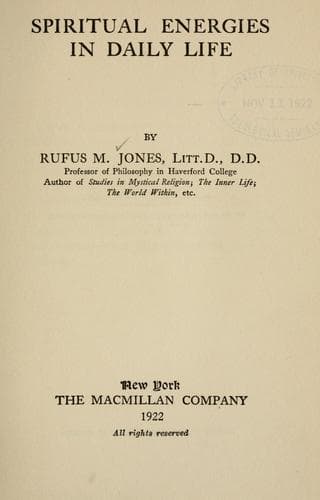
Spiritual Energies in Daily LifeJones, Rufus M. (Rufus Matthew)
Religion
Spiritual Energies in Daily Life
Jones, Rufus M. (Rufus Matthew)
Spiritual life
No theory certainly is sound which begins by cutting the subconscious
and the conscious life apart into two more or less dissociated selves.
There is every indication and evidence of continuity and correlation
between what is above and what is below the threshold which in any case
is as relative and artificial a line as is the horizon. The so-called
“uprushes” of the genius are finely correlated with his normal experience
into which they “uprush.” The “uprushes” which convey truth to Socrates
beautifully fit, first, the character of the man and, secondly, the
demands of the temporal environment. Dante’s “uprushes” correspond to
the psychological climate of the medieval world, and Shakespeare’s
“uprushes” are well suited to the later period of the Renaissance. All
subliminal communications are congruent and consonant with the experience
of the person who receives them. The visions of apocalyptic seers are
all couched in the imagery of the apocalyptic schools, and so, too, the
reports of mediums are all in terms of spiritualistic beliefs. We shall
never find the solution of our religious problems by dividing the inner
life of man into two unrelated selves, by whatever name we call them,
for any religion that is to be real must go all the way through us, must
unify all our powers, and must furnish a spring and power by which we
live here and now in the sphere of our consciousness, our character, and
our will.
It proves to be just as impossible to cut consciousness up into the
fragmentary bits or units called mind states, or to sunder it into
a so-called “self as knower” and “self as known.” Consciousness is
never a shower of shot—a series of discontinuous units. It is the most
completely integral unity known to us anywhere in the universe. There
are no “parts” to it; it is without breaks or gaps. It is one undivided
whole. The only unit we can properly talk about is our unique persisting
personal self in conscious relation to an environment. We can, of course,
treat consciousness in the abstract as an aggregate of states and we can
formulate a scientific account of this constructed entity as we can of
any other abstracted section of reality. But this abstracted entity is
forever totally different from the warm and intimate inner life within
us, as we actually live it and feel its flow. Any state or process which
we may talk about is only an artificial fragment of a larger, deeper
reality which gives the “fragment” its peculiar being and makes it what
it is. Underneath all that appears and happens in the conscious flow is
the personal self for whom the appearances occur. Any psychologist who
explicitly leaves this out of his account always implicitly smuggles it
in again.
Public-domain text, read in full here on John Shaqi.
Reviews
Reviews
No reviews yet
Be the first to share your thoughts on this work.
Elsewhere in the archive
Join the Discussion
Join the discussion
Sign in to leave a comment or review.
Sign InorCreate an account