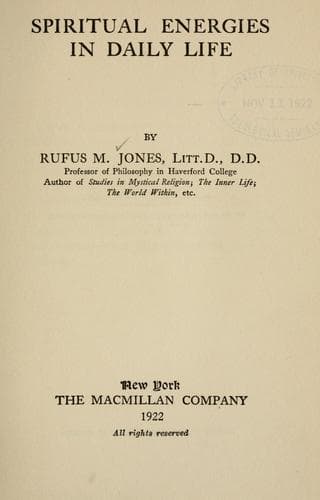
Spiritual Energies in Daily LifeJones, Rufus M. (Rufus Matthew)
Religion
Spiritual Energies in Daily Life
Jones, Rufus M. (Rufus Matthew)
Spiritual life
The most striking fact of experience is _knowing that we know_. The
same consciousness which knows any given object in the same pulse of
consciousness knows itself as knowing it. Self-consciousness is present
in all consciousness of objects. The thinker that thinks is involved in
and is bound up with all knowledge, even of the simplest sort. Every
idea, every feeling, and every act of will is what it is because it
is in living unity with our entire personal self. If any such “state”
got dissociated, slipped away and undertook to do business on its own
hook, it would be as unknown to us as our guardian angel is. The mind
that knows can never be separated from the world that is known. One can
think in abstraction of a mind apart by itself and of a world equally
isolated—but no such mind and no such world actually exist. To be a
real mind, a real self, is to be in active commerce with a real world
given in experience. One thinks his object in the same unified pulse
of consciousness in which he thinks himself and vice versa. There is
no self-consciousness without object-consciousness, and there is no
object-consciousness without self-consciousness. Outer and inner, knower
and known, are not two but forever one. The “soul,” therefore, is not
something hidden away in behind or above and beyond our ideas and
feelings and will activities. It is the active living unity of personal
consciousness—the one psychic integer and unit for a true psychology. It
binds all the items of experience into one indivisible unity, one organic
whole through which our personal type of life is made possible. At every
moment of waking, intelligent life we look out upon each fact, each
event, each experience from a wider self which organizes the new fact in
with its former experiences, weaves it into the web of its memories and
emotions and purposes, makes the new fact a part of itself, and yet at
the same time knows itself as transcending and outliving the momentary
fact.
When we study the personal self deeply enough, not as cut up into
artificial units, but as the living, undivided whole, which is implied in
all coherent experience, we find at once a basis for those ideal values
that are rightly called spiritual and for “those mighty hopes that make
us men.” The first step toward a genuine basis of spiritual life is to
be found in the restoration of the personal self to its true place as
the ultimate fact, or datum, of self-conscious experience. As soon as
we come back to this central reality, our unified, unique, self-active
personality, we find ourselves in possession of material enough; as
Browning would say,
“For fifty hopes and fears
As old and new at once as nature’s self,
To rap and knock and enter in our soul,
Take hands and dance there, a fantastic ring,
Round the ancient idol, on his base again,—
The grand Perhaps!”
Public-domain text, read in full here on John Shaqi.
Reviews
Reviews
No reviews yet
Be the first to share your thoughts on this work.
Elsewhere in the archive
Join the Discussion
Join the discussion
Sign in to leave a comment or review.
Sign InorCreate an account